DENARASE® High Salt – Salt-Tolerant Nuclease for High-Efficiency DNA Removal

SKU:BHZ16500002
New Featured GMP Available Peer-Reviewed Free Sample
Overview
Click light‑blue chips for details
DENARASE® High Salt is designed to retain activity at elevated salt and different pH levels. It is specifically engineered for use in development and manufacturing processes, that benefit from salt additions. The salt-tolerant enzyme efficiently cleaves all forms of DNA and RNA across a broad range of process-relevant conditions, facilitating flexible and more efficient production of biologicals, such as viral vectors and vaccines. DENARASE® High Salt GMP-grade manufacturing complies with EU GMP standards DENARASE® High Salt R&D-grade is produced under ISO 9001 standard Both quality grades of DENARASE® High Salt are technically equivalent, enabling a seamless transition from early R&D stages to biopharmaceutical manufacturing under GMP
Purity ≥ 98%
Activity > 250 U/µL
Salt Range 0–500 mM NaCl
Storage Temperature -20°C
Available Options

Select the variant that best fits your experiment. Availability and lead time may vary by option.

  • Options (2 dimensions):
    • Grade (2) – R&D, GMP
    • Size (7) – 25 kU, 100 kU, 500 kU, 1,000 kU, 5,000 kU (R&D); 1 MU, 5 MU (GMP)
  • Lead time: typically ships in 2–3 weeks; timing may vary by selected option.
  • Storage: Store at −20 °C ± 5 °C.
  • Shipping: cold-chain shipment (typically with ice packs).
  • Upon receipt: store at the recommended temperature as soon as possible.
  • Sales terms and conditions: Please review prior to ordering.
Options selector
Catalog no. Size Quality Grade
22002-25k 25 kU
22002-100k 100 kU
22002-500k 500 kU
22002-1000k 1000 kU
22002-5000k 5000 kU
22002-1M 1 MU
22002-5M 5 MU
Field Specification
Concentration > 250 U/µL
Endotoxin Level < 0.25 EU/kU
Expression System
  • Recombinant, Bacillus sp. (gram-positive)
Form Liquid solution
Formulation Buffered aqueous glycerol solution
Molecular Weight 27 kDa (per monomer)
Product Type
  • Enzyme
  • Endonuclease
Shipping Cold-chain shipment (typically with ice packs)
Source Recombinant, engineered from Serratia marcescens, expressed in Bacillus sp.
Species Serratia marcescens (engineered variant)
Storage −20 °C ± 5 °C
UniProt # P13717 (engineered variant)

About DENARASE® High Salt

How DENARASE® High Salt works

DENARASE® High Salt is an engineered version of the wild-type Serratia marcescens endonuclease. By introducing a few targeted amino acid substitutions, the enzyme was optimized for salt tolerance, retaining activity at higher salt concentrations without losing specificity for nucleic acids. DENARASE® High Salt exhibits high DNA removal activity across a broad range of salt concentrations (0–500 mM NaCl) and pH levels, providing greater flexibility in bioprocessing and enabling seamless integration into existing workflows.


Production of DENARASE® High Salt

DENARASE® High Salt is produced using a method nearly identical to the established, patented DENARASE® manufacturing process, based on expression in a gram-positive Bacillus sp. strain. Developed for commercial production of biologicals, the enzyme is manufactured under GMP conditions complying with EU GMP regulations. Produced without antibiotics, Triton X-100, animal-derived or TSE/BSE risk raw materials.


DENARASE® High Salt is available in two quality grades

DENARASE® High Salt for Research and Development (R&D) use & DENARASE® High Salt for manufacturing under GMP.

  • DENARASE® High Salt R&D-grade: produced under ISO 9001 standard; less stringent requirements for documentation, storage, and distribution.
  • DENARASE® High Salt GMP-grade: manufactured under EU GMP conditions; dedicated regulatory support via US FDA Drug Master File.
  • Both quality grades are technically equivalent, enabling a seamless transition from R&D to GMP manufacturing.

DENARASE® High Salt — Enzyme Characteristics

DENARASE® High Salt is engineered to maintain high DNA removal activity across a broad range of salt concentrations (0–500 mM NaCl) and pH levels. Magnesium (Mg2+) is an essential cofactor: optimal DENARASE® High Salt activity is observed between 5–25 mM Mg2+. The enzyme is highly effective at process-relevant pH 7.4 with standard magnesium supplementation (5 mM MgCl2).


Salt & Magnesium Concentration
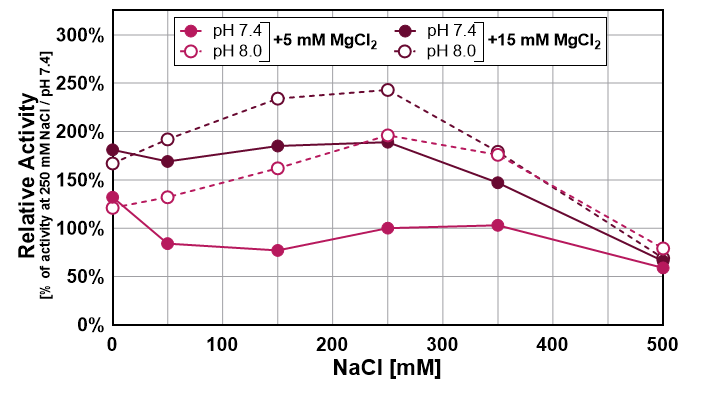
Effect of NaCl, pH and magnesium on DENARASE® High Salt activity

Fig. 1: Effect of NaCl, pH and magnesium
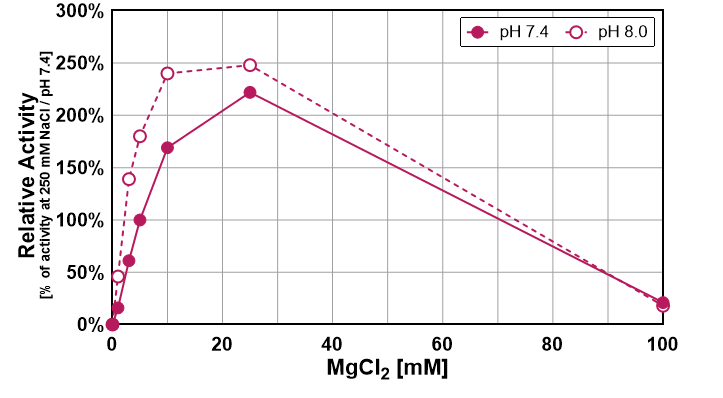
Effect of magnesium on DENARASE® High Salt activity

Fig. 2: Effect of magnesium


pH & Temperature
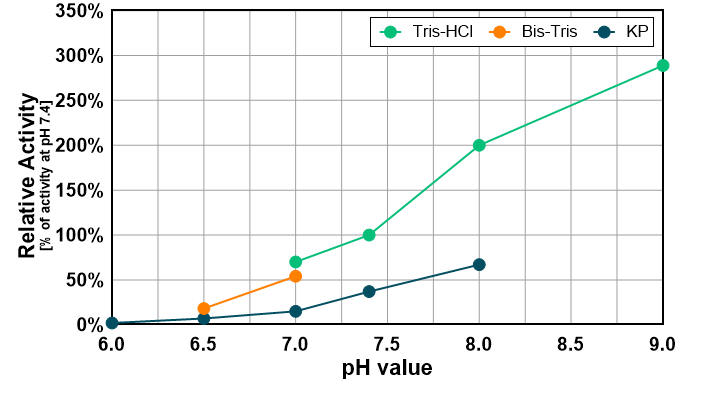
Effect of pH value in different buffer systems on DENARASE® High Salt activity
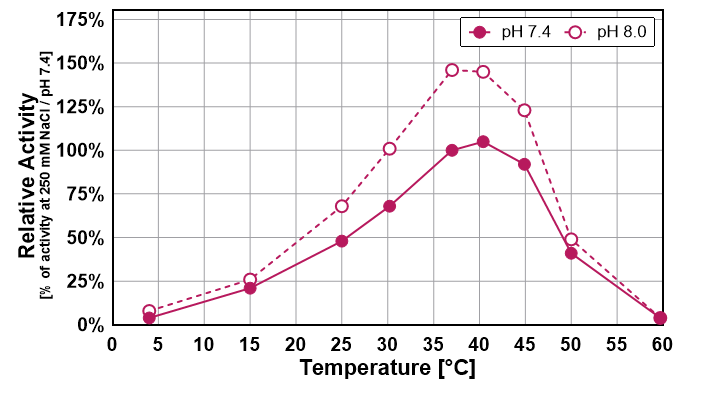
Fig. 3: Effect of pH value in different buffer systems

Effect of temperature on DENARASE® High Salt activity

Fig. 4: Effect of temperature


Key Characteristics & Optimal Conditions

Molecular Weight (calculated)27 kDa (per monomer)
CofactorMg2+ (optimum 5–25 mM)
pH OptimumpH 7.4–9.0
Temperature Optimum37 °C
Isoelectric Point (pI, calculated)7.83
Active NaCl Range0–500 mM
Compared to standard DENARASE®: higher pI (7.83 vs. 6.2), wider Mg2+ optimum (5–25 mM vs. 1–5 mM), active at pH 7.4 under high-salt conditions.

Product Specification

In order to ensure a constant and high-quality level for DENARASE® High Salt, each batch must fulfill the in-house acceptance criteria listed below.

CriteriaMethodSpecification
AppearanceVisualClear, transparent solution
ActivityPhotometric1> 250 U/µL
PurityProtein purity determined by SDS-PAGE and silver staining≥ 98%
Specific ActivityActivity per protein content determined photometrically at 280 nm with a molar extinction coefficient of 44,600 L × mol−1 × cm−1> 4 × 10⁵ U/mg
Endotoxin LevelLAL-Test acc. to Ph. Eur. 2.6.14 / USP <85>, Method C< 0.25 EU/kU
Total Microbial CountTAMC/TYMC acc. to Ph. Eur. 2.6.12 / USP <61>Aerobic bacteria: < 5 cfu/200 µL
Yeast/moulds: < 5 cfu/200 µL
Unit definition1: One unit (U) will digest salmon sperm DNA to acid-soluble oligonucleotides equivalent to a ΔA260nm of 1.0 in 30 min at pH 8.0 at 37 °C. Release assay conditions: 250 mM NaCl and 5 mM MgCl2. Note: unit definitions for DENARASE® and DENARASE® High Salt are not directly comparable.

Storage & Conditions

When stored under recommended conditions (−20 °C ± 5 °C), the enzyme is stable for at least 12 months. Long-term stability is currently under investigation. Note: It is not recommended to store the product at −70 °C or below, as deep freezing will cause loss of activity.


Packaging Information

DENARASE® High Salt is filled in non-pyrogenic, USP Class VI compliant vials. Product vials are shipped under qualified cooled conditions. The shipping temperature may differ from the recommended storage temperature without affecting product quality. All DENARASE® High Salt products are delivered by c-LEcta in a sealed secondary packaging with tamper-evident seals.

General

DENARASE® High Salt is an engineered variant of the standard enzyme. A few amino acid substitutions increase salt tolerance without affecting nucleic acid specificity.

No. Both products address distinct application needs and will continue to co-exist in the portfolio.

c-LEcta published comparative data covering the development of DENARASE® High Salt and its performance vs. other commercially available salt-tolerant endonucleases for viral vector manufacturing. Available upon request via the sales team.

The estimated delivery time is 2–3 weeks worldwide.

Usage & Application

Hydrolyzes phosphodiester bonds leaving ~3–5 bp fragments. Active on all nucleic acid forms (ss/ds, linear, circular, supercoiled). Engineered salt tolerance makes it ideal for bioprocess steps at elevated ionic strengths.

Recommended for processes above 150 mM NaCl.

Release assay: 250 mM NaCl / 5 mM MgCl2 — units are not directly comparable to standard DENARASE®; create a process-specific activity profile.

Mg2+ must be raised to ≥5 mM (range 5–25 mM depending on NaCl and pH; 15 mM suggested for initial tests). Starting concentration: 10–100 U/mL.

Above 150 mM NaCl as a general rule. For 150–250 mM, test both enzymes — pH and Mg2+ also influence activity in this range.

Viral Vector Production (AAV, Lentivirus / HEK293): used during/after cell lysis in high-salt buffer conditions to reduce viscosity and facilitate purification.
Vaccine Manufacturing (live attenuated, inactivated, VLP): reduces host cell DNA under elevated ionic strength, enhances process robustness.

Enzyme Characteristics & Quality Grades

Two grades — both technically equal with the same specification parameters.
R&D grade: ISO 9001; less strict documentation and distribution requirements.
GMP grade: EU GMP; US FDA Drug Master File support; GDP-compliant distribution.

Yes. The DENARASE® ELISA Kit can quantify DENARASE® High Salt, but since the standard is calibrated for the wild-type enzyme, a correction factor of 1.46 must be applied. Alternatively, generate a separate High Salt standard curve.

Process Integration & Quality Control

Anion exchange, cation exchange, hydrophobic interaction, hydroxyapatite, or size exclusion chromatography. Filtration techniques can also apply. Media selection must be evaluated per specific case.

The DENARASE® ELISA Kit detects residual enzyme to 12 pg/mL via monoclonal antibodies.

Important: Apply correction factor 1.46 when using the standard kit, or generate a separate DENARASE® High Salt standard curve.

Note: NaCl >1 M required for inactivation (vs ~600 mM for standard DENARASE®).

Potassium phosphate (200–300 mM) can also quench activity. EDTA (>5 mM) removes free Mg2+ ions and inhibits the reaction.

Yes. All batches must meet the endotoxin specification (<0.25 EU/kU) prior to product release. See the Validation Guide for full details.

DENARASE® Scientific Publications

A selection of peer-reviewed publications and reports referencing or featuring DENARASE®.

Viral Vectors for Gene Therapy and Vaccine Production

22 publications
Developing a robust and scalable platform for AAV8 production
Nascimento, André et al.
Journal of Biotechnology, Vol. 408, 72–79, December 2025 · doi: 10.1016/j.jbiotec.2025.09.002
View Publication →
Abundance-biased codon diversification prevents recombination in AAV production and ensures robust in vivo expression of functional FRET sensors
Dernic, Jan et al.
Communications Biology vol. 8,1 1244, 19 Aug. 2025 · doi: 10.1038/s42003-025-08677-6
View Publication →
Salt-tolerant endonucleases, the benefits for viral vector manufacturing and a comparison of two marketed enzymes
Marc Struhalla, Svenja Michalek
Cell & Gene Therapy Insights 2025; 11(3), 305–317, 26 March 2025 · doi: 10.18609/cgti.2025.035
View Publication →
Timed chromatin invasion during mitosis governs prototype foamy virus integration site selection and infectivity
Lagadec, Floriane et al.
Nucleic Acids Research vol. 53,10 gkaf449, 31 May 2025 · doi: 10.1093/nar/gkaf449
View Publication →
A two-pass anion-exchange chromatography strategy for enrichment of full capsids in manufacturing of adeno-associated viral vectors
Thakur, Garima et al.
Molecular Therapy. Methods & Clinical Development vol. 33,2 101441, 3 Mar. 2025 · doi: 10.1016/j.omtm.2025.101441
View Publication →
Recombinant AAV batch profiling by nanopore sequencing elucidates product-related DNA impurities and vector genome length distribution
Dunker-Seidler, Florian et al.
Molecular Therapy. Methods & Clinical Development 33,1 101417, 22 Jan. 2025 · doi: 10.1016/j.omtm.2025.101417
View Publication →
Polo-like kinase inhibitors increase AAV production by halting cell cycle progression
Fisher, Kaylin et al.
Molecular Therapy. Methods & Clinical Development vol. 33,1 101412, 17 Jan. 2025 · doi: 10.1016/j.omtm.2025.101412
View Publication →
Selective Enhancement of REM Sleep in Male Rats through Activation of Melatonin MT1 Receptors Located in the Locus Ceruleus Norepinephrine Neurons
López-Canul, Martha et al.
The Journal of Neuroscience vol. 44,29 e0914232024, 17 Jul. 2024
View Publication →
In vivo CAR T-cell generation in nonhuman primates using lentiviral vectors displaying a multidomain fusion ligand
Nicolai, Christopher J et al.
Blood vol. 144,9 (2024): 977–987
View Publication →
Unveiling the secrets of adeno-associated virus: novel high-throughput approaches for the quantification of multiple serotypes
Meierrieks, Frederik et al.
Molecular Therapy. Methods & Clinical Development vol. 31 101118, 2023
View Publication →
Scaling Up of Steric Exclusion Membrane Chromatography for Lentiviral Vector Purification
Labisch et al.
Membranes 13(2): 149 (2023)
View Publication →
Incubation Temperature and Period During Denarase Treatment and Microfiltration Affect the Yield of Recombinant Adenoviral Vectors During Downstream Processing
Sonogür et al.
Molecular Biotechnology 65(7): 1129–1139 (2023)
View Publication →
Efficient clinical-grade γ-retroviral vector purification by high-speed centrifugation for CAR T cell manufacturing
Mekkaoui et al.
Molecular Therapy. Methods & Clinical Development 28: 116–128 (2022)
View Publication →
Comparison of the performance of anion exchange membrane materials for adenovirus purification using laterally-fed membrane chromatography
Kawka et al.
Biochemical Engineering Journal 182: 108417 (2022)
View Publication →
Steric exclusion chromatography of lentiviral vectors using hydrophilic cellulose membranes
Labisch et al.
Journal of Chromatography A 1674: 463148 (2022)
View Publication →
Integrated development of enzymatic DNA digestion and membrane chromatography processes for the purification of therapeutic adenoviruses
Kawka et al.
Separation and Purification Technology 254: 117503 (2021)
View Publication →
A new simplified clarification approach for lentiviral vectors using diatomaceous earth improves throughput and safe handling
Labisch et al.
Journal of Biotechnology 326: 11–20 (2021)
View Publication →
Scalable upstream process development for the suspension-based production of lentiviral vectors for CAR T cell therapies with multiparallel & benchtop bioreactor systems & DoE methodology
Riethmüller et al.
Cell & Gene Therapy Insights 7(6): 689–700 (2021)
View Publication →
Transfer and scale-up from 10 L BioBLU® to Allegro™ STR 50 and STR 200 Bioreactors
Mainwaring et al.
Cell & Gene Therapy Insights 7(9): 1347–1362 (2021)
View Publication →
Scalability comparison between 50 and 500 liter stirred tank bioreactor for production of rAAV viral vector
Sanderson et al.
Cell & Gene Therapy Insights 7(9): 1025–1033 (2021)
View Publication →
Cell culture-based production and in vivo characterization of purely clonal defective interfering influenza virus particles
Hein et al.
BMC Biology 19(1): 91 (2021)
View Publication →
Highly Efficient Purification of Recombinant VSV-ΔG-Spike Vaccine against SARS-CoV-2 by Flow-Through Chromatography
Lerer et al.
BioTech 10(4): 22 (2021)
View Publication →
A high cell density perfusion process for Modified Vaccinia virus Ankara production: Process integration with inline DNA digestion and cost analysis
Gränicher, Gwendal et al.
Biotechnology and Bioengineering 118(12): 4720–4734 (2021)
View Publication →

Production of Virus-like Particles (VLP)

10 publications
Optimizing nuclease treatment to enhance anion exchange chromatography of HIV-derived virus-like particles
M. S. von Elling-Tammen
Journal of Chromatography B vol. 1256 124539, 2025 · doi: 10.1016/j.jchromb.2025.124539
View Publication →
Production of an immunogenic trivalent poliovirus virus-like particle vaccine candidate in yeast using controlled fermentation
Sherry, Lee et al.
NPJ Vaccines 10,1 64, 31 Mar. 2025 · doi: 10.1038/s41541-025-01111-2
View Publication →
Preclinical evaluation of manufacturable SARS-CoV-2 spike virus-like particles produced in Chinese Hamster Ovary cells
Alpuche-Lazcano et al.
Communications Medicine 3(1): 116 (2023)
View Publication →
Development of modern immunization agent against bovine papillomavirus type 1 infection based on BPV1 L1 recombinant protein
Vrablikova et al.
Frontiers in Veterinary Science 10: 1116661 (2023)
View Publication →
Production of antigenically stable enterovirus A71 virus-like particles in Pichia pastoris as a vaccine candidate
Kingston et al.
bioRxiv (Preprint, 2023)
View Publication →
VelcroVax: a "Bolt-On" Vaccine Platform for Glycoprotein Display
Kingston et al.
mSphere 8(1): e0056822 (2023)
View Publication →
Production and Characterisation of Stabilised PV-3 Virus-like Particles Using Pichia pastoris
Sherry et al.
Viruses 14(10): 2159 (2022)
View Publication →
Protease-Independent Production of Poliovirus Virus-like Particles in Pichia pastoris: Implications for Efficient Vaccine Development and Insights into Capsid Assembly
Sherry et al.
Microbiology Spectrum 11(1): e0430022 (2023)
View Publication →
Development and preclinical evaluation of virus-like particle vaccine against COVID-19 infection
Yilmaz et al.
Allergy 77(1): 258–270 (2022)
View Publication →
Separation of influenza virus-like particles from baculovirus by polymer-grafted anion exchanger
Reiter et al.
Journal of Separation Science 43(12): 2270–2278 (2020)
View Publication →

Production of Bacteriophages

2 publications
In situ targeted base editing of bacteria in the mouse gut
Brödel, Andreas K et al.
Nature vol. 632,8026 (2024): 877–884
View Publication →
Phage therapy potentiates second-line antibiotic treatment against pneumonic plague
Vagima et al.
Viruses 14(4): 688 (2022)
View Publication →

Biofilm Removal

2 publications
Targeting Staphylococcus aureus biofilm-related infections on implanted material with a novel dual-action thermosensitive hydrogel containing vancomycin and a tri-enzymatic cocktail: in vitro and in vivo studies
Buzisa Mbuku, Randy et al.
Biofilm vol. 9 100288, 20 May 2025 · doi: 10.1016/j.bioflm.2025.100288
View Publication →
Hydrolytic Enzymes as Potentiators of Antimicrobials against an Inter-Kingdom Biofilm Model
Ruiz-Sorribas et al.
Microbiology Spectrum 10(1): e02589-21 (2022)
View Publication →

Protein Purification

5 publications
Novel fold and wing structure of Forkhead transcription factor facilitate DNA binding
Wang, George L et al.
Nucleic Acids Research vol. 53,18 (2025): gkaf946 · doi: 10.1093/nar/gkaf946
View Publication →
Mapping the genetic landscape of iron metabolism uncovers the SETD2 methyltransferase as a modulator of iron flux
Martinelli, Anthony W et al.
Science Advances vol. 11,38 (2025): eadw9095 · doi: 10.1126/sciadv.adw9095
View Publication →
Granulins rescue inflammation, lysosome dysfunction, lipofuscin, and neuropathology in a mouse model of progranulin deficiency
Root, Jessica et al.
Cell Reports 43,12 (2024): 114985 · doi: 10.1016/j.celrep.2024.114985
View Publication →
Effective removal of host cell-derived nucleic acids bound to hepatitis B core antigen virus-like particles by heparin chromatography
Valentic, Angela, and Jürgen Hubbuch
Frontiers in Bioengineering and Biotechnology 12 1475918, 3 Oct. 2024 · doi: 10.3389/fbioe.2024.1475918
View Publication →
Deubiquitinating enzyme mutagenesis screens identify a USP43-dependent HIF-1 transcriptional response
Pauzaite, Tekle et al.
The EMBO Journal vol. 43,17 (2024)
View Publication →

Research budgets are tight — we get it. That's why we've put together a fresh round of exclusive promotions designed to help you stock up on the reagents, kits, and consumables your lab depends on, without stretching your budget.

🔬 What's on offer right now:

10% Off Pre-Designed siRNA Sets

20% Off Transmembrane Proteins

$50 Off All ELISA Kits

50% Off Lab Consumables + Free Shipping

$99 Pipette Filler Promotion Package

BlasTaq 2X qPCR MasterMix - 50% OFF Limited Time Offer

DENARASE® Endonuclease — 10% Off One Order

10% OFF CELL LINES-Limited-Time Offer

Free Sample – CellTrypase Recombinant Trypsin-Like Enzyme

Free Sample – MycoFold™ Growth Factors

Get a Quote

Please use this form for bulk quantity requests or customized products.

Contact Information

Product Information

Try Celltrypse Free – Request Your Sample Today

Experience the power of Celltrypse™, c-LEcta's innovative enzyme solution for gentle and efficient cell dissociation. Request your free sample and discover a superior alternative for your cell culture workflows.

Try Celltrypse Free – Request Your Sample Today

Try Celltrypse Free – Request Your Sample Today

Experience the power of Celltrypse™, c-LEcta's innovative enzyme solution for gentle and efficient cell dissociation. Request your free sample and discover a superior alternative for your cell culture workflows.

Try Celltrypse Free – Request Your Sample Today