

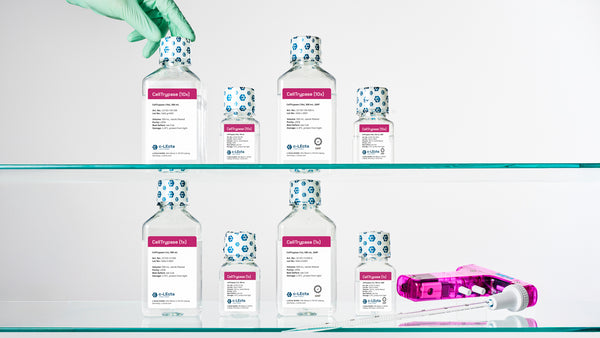
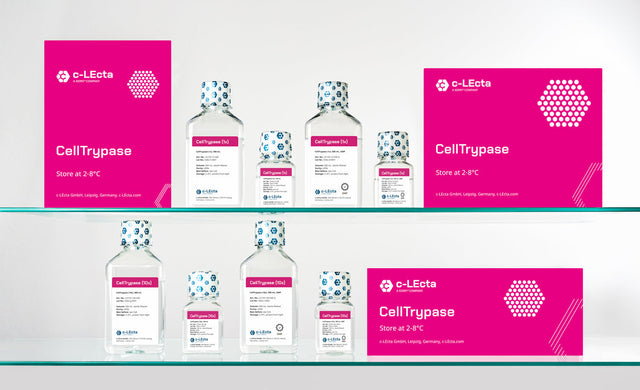
CellTrypase is supplied as a sterile-filtered liquid in non-pyrogenic PET bottles with HDPE screw caps, in 100 mL and 500 mL sizes.

CellTrypase – Recombinant Trypsin-Like Enzyme for Cell Dissociation
CellTrypase is a recombinant, animal origin-free trypsin-like enzyme from Kerry (formerly c-LEcta) — a fungal serine protease (Fusarium oxysporum) produced by Bacillus fermentation. Every lot is released at ≥95% HPLC purity. It dissociates adherent cells gently and quenches by dilution in medium, with no trypsin inhibitor required. Kerry's five-passage data in CHO-K1, HEK 293, MDCK and Vero, and its 2D/3D human iPSC data, show viability, yield and doubling times equal to or better than the industry-standard trypsin-like enzyme. Available in R&D and GMP grades, 1× ready-to-use or 10× concentrate. The enzyme is supplied sterile-filtered in PBS with EDTA, in 100 mL and 500 mL bottles. Store at 2–8 °C, where Kerry confirms stability for at least 21 months; it ships at ambient temperature, so no cold chain is needed. The GMP grade is made under a quality system compliant with the EXCiPACT® certification standard and comes with the documentation qualification teams ask for — Certificate of Analysis, Safety Data Sheet, and animal origin-free and TSE/BSE declarations. A free 100 mL sample is available to test on your own cells before you switch.
| Catalog No. | Quality Grade | Concentration | Volume | Availability | Price | Qty | Order |
|---|---|---|---|---|---|---|---|
| 22103-1X-100 | R&D Grade | 1x (Ready-to-Use) | 100 mL | In Stock | $32.00 |
|
|
| 22103-1X-500 | R&D Grade | 1x (Ready-to-Use) | 500 mL | In Stock | $110.00 |
|
|
| 22103-10X-100 | R&D Grade | 10x (Concentrated Stock) | 100 mL | In Stock | $104.00 |
|
|
| 22103-10X-500 | R&D Grade | 10x (Concentrated Stock) | 500 mL | In Stock | $451.00 |
|
|
| 22103-1X-100-G | GMP Grade | 1x (Ready-to-Use) | 100 mL | In Stock at Manufacturer | $42.00 |
|
|
| 22103-1X-500-G | GMP Grade | 1x (Ready-to-Use) | 500 mL | In Stock at Manufacturer | $146.00 |
|
|
| 22103-10X-100-G | GMP Grade | 10x (Concentrated Stock) | 100 mL | In Stock at Manufacturer | $138.00 |
|
|
| 22103-10X-500-G | GMP Grade | 10x (Concentrated Stock) | 500 mL | In Stock at Manufacturer | $602.00 |
|
Choose Quality Grade, then Concentration.
Overview
What is CellTrypase – Recombinant Trypsin-Like Enzyme for Cell Dissociation?
Scientific background
Trypsin-like serine proteases cleave peptide bonds on the carboxyl side of lysine and arginine residues — the same chemistry exploited during cell dissociation. Conventional porcine trypsin carries the biosafety considerations associated with animal-derived materials, including lot-to-lot variability and the theoretical risk of adventitious agents. Recombinant, non-mammalian alternatives remove the animal origin entirely and are produced under controlled fermentation conditions.
CellTrypase is a recombinant trypsin-like enzyme derived from Fusarium oxysporum and produced by microbial fermentation using Bacillus sp. as the expression host. Its fungal origin confers lower non-specific reactivity than mammalian trypsin, and the calculated molecular weight of the single-chain enzyme is approximately 22 kDa1.
Product description
CellTrypase is manufactured in-house at the Kerry Biotechnology Centre in Leipzig, Germany, by c-LEcta GmbH — now operating as Kerry (formerly c-LEcta) — under a certified quality management system. It is available in two grades — a GMP grade produced under a QMS compliant with the EXCiPACT® certification standard for pharmaceutical excipients, and an R&D grade manufactured under ISO 9001 — and in two concentration formats, 1× ready-to-use and 10× concentrated stock, supplied in 100 mL and 500 mL bottles. Both grades are made by the same process and are released against the same specification.
The formulation is a sterile-filtered liquid in PBS with 1.1 mM EDTA. Supplying the enzyme as a liquid removes drying and reconstitution steps, which preserves enzyme integrity and gives a clear, ready-to-use solution.
Measured dissociation performance
Kerry tested the 1× working solution on four adherent production cell lines over five consecutive passages (n = 3 technical replicates), measuring dissociation time, viability, cell yield and population doubling time against the current industry-standard trypsin-like enzyme as the control. The comparator is not named in the source documents; it is described only as the "current industry standard trypsin-like enzyme".
| Cell line | Dissociation time (min:s) control → CellTrypase |
Mean viability control → CellTrypase |
Mean yield (% of control) | Doubling time (h:min) control → CellTrypase |
|---|---|---|---|---|
| CHO-K1 | 02:30 → 02:25 | 97% → 98% | 106% | 15:17 → 14:47 |
| HEK 293 | 02:46 → 02:27 | 95% → 95% | 100% | 27:10 → 26:55 |
| MDCK | 25:23 → 23:32 | 99% → 99% | 102% | 19:09 → 18:52 |
| Vero | 03:59 → 04:07 | 99% → 99% | 103% | 19:45 → 19:16 |
Mean viability and yield are averages across five passages (P0–P4); yield is expressed relative to the industry-standard control. MDCK is a tightly adherent line and takes over 20 minutes with either enzyme. Source: Kerry scientific poster "Advancing cell dissociation in bioprocessing with CellTrypase" (Feb 2026) and CellTrypase Product Information Sheet v4.0 (Aug 2026).
Kerry also reports data in human induced pluripotent stem cells (iPSCs), the most sensitive system tested. In 2D colonies, 1× CellTrypase reached single-cell suspension in 5 minutes versus 7 minutes for the control, with 94% viability for both enzymes, 99% relative yield, residual aggregates below 5%, and pluripotency marker expression (Oct3/4, SSEA4, TRA-1-60, CD30, Nanog, Sox2, SSEA3) above the 75% acceptance threshold by flow cytometry. In 3D iPSC aggregates, both enzymes took about 10 minutes; CellTrypase gave 87% viability (control 85%), 104% relative yield and fewer residual aggregates (12% versus 16%).
| Human iPSC format | Dissociation time control → CellTrypase |
Viability control → CellTrypase |
Yield (% of control) | Residual aggregates control → CellTrypase |
|---|---|---|---|---|
| 2D colonies | 7 min → 5 min | 94% → 94% | 99% | <5% → <5% |
| 3D pluripotent aggregates | 10 min → 10 min | 85% → 87% | 104% | 16% → 12% |
1× CellTrypase versus the industry-standard control; mean ± SD of n = 3 technical replicates. Source: Kerry poster, Feb 2026. Data on differentiated 3D iPSC aggregates and the full five-passage figure set for each cell line are in the CellTrypase Application Note v1.1, which Kerry supplies on request — request it here.
CellTrypase requires no trypsin inhibitor for inactivation — quenching by dilution in fresh medium is sufficient. Every lot is released at ≥95% purity by size-exclusion HPLC; the chromatogram of the 10× GMP stock shows a single, well-defined peak, whereas the industry-standard comparator shows a broader peak base with small additional signals (see Validation & QC below).
Intended applications
Kerry specifies CellTrypase for gentle, efficient dissociation of adherent and aggregating cells in biopharmaceutical manufacturing and research, including:
- Passaging and expansion of adherent production lines such as CHO-K1, HEK 293, Vero and MDCK
- Cell dissociation in viral vector and viral vaccine production for cell and gene therapies
- Passaging of human iPSCs in 2D and 3D culture, with pluripotency marker expression preserved
- Sensitive cell types such as hESCs, primary cell isolation, organoid and 3D culture models, cell banking and differentiation workflows
Released comparative data cover CHO-K1, HEK 293, MDCK, Vero and human iPSCs (2D, 3D and differentiated 3D aggregates). Performance on other cell types — hESC, primary cells, organoids, MSCs and others — is stated by the manufacturer as an intended use but is not backed by published figures. As with any change of raw material, qualify the enzyme on your own cells before adopting it in a routine or regulated workflow. A free 100 mL sample is available for exactly that purpose.
Inactivation and handling
CellTrypase requires no special inhibitor. After the cells detach, quench the reaction by adding fresh medium, serum-free or serum-containing. For complete enzyme removal, centrifuge and resuspend the cells in fresh medium. Residual enzyme can be quantified with commercially available ELISA kits for recombinant fungal trypsin-like enzymes; Kerry has experimentally confirmed compatibility with these assay formats.
Quick method for adherent cells:
- Pre-warm the enzyme and medium to room temperature or 37 °C — warmer temperatures accelerate detachment
- Remove spent medium and rinse the monolayer with Ca²⁺/Mg²⁺-free PBS
- Add approximately 1 mL of the 1× solution per 25 cm²
- Incubate until the cells detach — check the monolayer rather than relying on a fixed time; tap the vessel or pipette gently if needed
- Quench with fresh medium; centrifuge if the enzyme must be removed
The 10× concentrate may be used undiluted for fast detachment of strongly adherent cells or diluted to 1× in PBS containing 1 mM EDTA under sterile conditions. The enzyme is most active between pH 7.0 and 10.0 and between 20 and 37 °C; activity falls sharply above 60 °C and is minimal below pH 6.
Storage and shipping
Store at 2–8 °C, protected from light. Kerry's Product Information Sheet v4.0 (August 2026) confirms stability for at least 21 months from the date of manufacture at 2–8 °C for both the GMP and R&D grades, based on real-time stability data; long-term stability is still under investigation and the shelf life is extended as data accumulate. Temporary exposure to room temperature or above during shipment does not affect enzyme activity, so the product ships at ambient temperature and no cold chain is required. Avoid extended storage at or near 37 °C, which causes a gradual loss of activity through autoproteolysis.
Regulatory support and documentation
Kerry provides documentation to support customer qualification, validation and regulatory submissions, including Certificate of Analysis, Safety Data Sheet, animal origin-free declarations, TSE/BSE statements, packaging details, change notifications and quality agreements. Both grades are manufactured without antibiotics, animal-derived raw materials or TSE/BSE-risk materials; the production host is a GMO of safety level S1 and the final product contains no GMO. The Product Information Sheet v4.0 and the four v4.0 product specifications are available below. The CellTrypase Validation Guide v1.2 (release test methods, stability and regulatory statements) and the Application Note v1.1 (full performance data) are supplied on request through the technical documents page.
1 Calculated using Clone Manager 12 Professional Edition (Sci Ed Software); reflects calculation according to Lehninger. Unit definition: one unit (U) forms 1 µmol p-nitroaniline per minute at 37 °C from 8 mM L-AAPA at pH 8.0.
For Research Use Only. GMP-grade material is intended as a processing aid in biopharmaceutical manufacturing and is not for direct administration to humans or animals. Manufactured and distributed by c-LEcta GmbH, Kerry Biotechnology Centre, Leipzig, Germany — Kerry (formerly c-LEcta). CellTrypase is a trademark of Kerry Group. Free 100 mL samples are available for qualification and process-development testing.
Details
Specifications
Applications
Applications & how to use
Quick protocol — adherent cell dissociation
- Pre-warm CellTrypase and culture medium to room temperature or 37 °C. Warmer temperatures accelerate detachment.
- Remove the spent medium and rinse the cell monolayer with PBS.
- Add CellTrypase to fully cover the cell layer — approximately 1 mL of the 1× solution per 25 cm² of surface area.
- Incubate until the cells detach. Monitor visually and tap the vessel gently if needed. Release time varies widely between cell lines, so determine the endpoint by eye rather than fixing one incubation time across a facility.
- Optional: if the cells do not fully detach, pipette gently up and down. This helps with sensitive or tightly adherent cell types.
- Quench enzymatic activity by adding fresh medium. No trypsin inhibitor is required.
- Optional: for complete removal of the enzyme, centrifuge and resuspend the cells in fresh medium.
Using the 10× stock. It may be used undiluted for fast detachment of strongly adherent cells, or diluted to 1× in PBS containing 1 mM EDTA under sterile conditions. For most applications a 1× working concentration gives efficient release while maintaining high viability.
Source: CellTrypase Product Information Sheet v4.0 (Kerry, 18 August 2026), section 3. For GMP workflows, request the lot-specific Certificate of Analysis and the animal origin-free and TSE/BSE declarations before qualification.
Cell Culture (Growth)
Routine expansion and maintenance of cell lines in adherent or suspension format. Reagent quality directly affects doubling time, morphology and the reproducibility of any downstream assay.
Cell Dissociation
Enzymatic or non-enzymatic detachment of adherent cells from their growth surface for passaging, counting or harvest. The goal is complete detachment with intact surface proteins and high post-dissociation viability.
Primary Cell Isolation
Release of primary cells from tissue or from a primary monolayer. Primary cells tolerate proteolysis poorly, so gentle, well-specified enzyme activity is critical for yield and phenotype retention.
Stem Cell Culture
Maintenance and passaging of iPSCs, hESCs and organoids. These cultures are sensitive to over-digestion, which causes loss of pluripotency markers, differentiation bias and reduced replating efficiency.
Viral Vector Production
Manufacture of AAV, lentiviral and adenoviral vectors in producer lines such as HEK 293 — from cell expansion through harvest, lysis and clarification. Every processing aid used along this chain, from the dissociation enzyme to the nuclease that clears host cell DNA, must carry documentation suitable for regulatory submission.
Vaccine Production
Propagation of viral vaccine substrates in cell lines such as Vero and MDCK, followed by harvest and clearance of host cell DNA from the bulk. Animal origin-free processing aids reduce adventitious-agent risk and simplify the regulatory dossier.
Cell Banking
Preparation and expansion of master and working cell banks. Consistency between lots of the reagents used at banking directly affects the comparability of every batch produced afterwards.
Evidence
Validation & QC · lot-released against spec
Release metrics and QC figures are provided per lot; full numeric values are on the lot-specific CoA.
Manufacturing
How it's made & quality control
Fermentation in Bacillus sp.
CellTrypase is expressed recombinantly in a Bacillus sp. host — gram-positive and endotoxin-free, classified as a safety-level-S1 GMO. Fermentation runs without antibiotics, animal-derived raw materials or TSE/BSE-risk substances, and the final product contains no GMO. Bulk enzyme is produced entirely in-house at the Kerry Biotechnology Centre in Leipzig with no external sourcing, and the same fermentation process feeds both the GMP and the R&D grade.
Purification and liquid formulation
Chromatographic purification takes every batch to the release specification of at least 95% purity by size-exclusion HPLC. The process avoids drying and reconstitution steps, which preserves enzyme integrity, and the purified enzyme is formulated as a sterile liquid in PBS with 1.1 mM EDTA — supplied at 1x ready-to-use or 10x concentrated strength. No ICH Q3C class 1 or 2 solvents are used; ethanol serves only to store reusable chromatography media between runs and is washed out before the media re-enter production.
Sterile fill and batch release
The formulation is sterile filtered and filled under aseptic conditions in a controlled cleanroom, into non-pyrogenic PET bottles with HDPE screw caps and a tamper-evident seal (USP Class VI materials). GMP grade runs under an EXCiPACT-compliant quality system and R&D grade under ISO 9001 — same process, same specification. Every batch is released against the full specification listed above, including:
QC assaysResources
Documents & downloads
Questions
Frequently asked questions
What is CellTrypase, and what is it used for?
CellTrypase is a recombinant trypsin-like serine protease derived from Fusarium oxysporum and produced by microbial fermentation in Bacillus sp. It cleaves on the carboxyl side of lysine and arginine residues — the same chemistry as conventional trypsinization — but contains no animal-derived material. It is used to dissociate adherent cells for passaging, expansion and harvest in research and biopharmaceutical manufacturing.
Who makes CellTrypase — Kerry or c-LEcta?
Both names refer to the same manufacturer. CellTrypase is made by c-LEcta GmbH at the Kerry Biotechnology Centre in Leipzig, Germany. c-LEcta remains the legal manufacturer and contractual partner, but the products and documentation are being rebranded under the Kerry name, so current documents read "Kerry (formerly c-LEcta)". BioHippo is the authorized United States distributor.
What is the difference between the GMP grade and the R&D grade?
Same enzyme, different quality system and documentation. The R&D grade is manufactured under ISO 9001 and is intended for research, process development and preclinical work. The GMP grade is produced under a quality management system compliant with the EXCiPACT certification standard for pharmaceutical excipients and is intended for clinical-phase and commercial biologics manufacturing; it is supplied with the regulatory documentation package, including Certificate of Analysis, Safety Data Sheet, animal origin-free and TSE/BSE declarations, change notification and quality agreements. Both grades are made by the same process and meet identical product specifications.
What is the difference between the 1x and 10x formats?
The 1x is ready to use as supplied, at an activity of 0.6–1.2 kU/L. The 10x is the same enzyme at ten times that activity, 6–12 kU/L, supplied as a concentrate to reduce storage volume and shipping cost; dilute it to 1x in PBS containing 1 mM EDTA, or use it undiluted for fast detachment of strongly adherent cells or dense 3D aggregates. If your consumption is low, the 1x avoids a dilution step. If you use large volumes or have limited cold storage, the 10x is usually more economical.
What sizes and configurations are available?
Eight configurations: two grades (R&D and GMP), two concentrations (1x ready-to-use and 10x concentrate) and two bottle sizes (100 mL and 500 mL). Current pricing and availability for each are in the ordering table on this page.
What purity, activity and endotoxin specification does each lot meet?
Every lot is released to ≥95% purity by size-exclusion HPLC. Activity is 0.6–1.2 kU/L for the 1x and 6–12 kU/L for the 10x, measured photometrically at 37 °C with 8 mM L-AAPA at pH 8.0, where one unit forms 1 µmol p-nitroaniline per minute. Endotoxin is ≤1 EU/mL (1x) and ≤10 EU/mL (10x) by LAL. pH is 7.1–7.6 and osmolality 270–320 mOsm/kg. Mycoplasma is tested negative by qPCR and sterility passes Ph. Eur. 2.6.1 / USP <71>. The lot-specific Certificate of Analysis carries the actual measured values.
Which cell lines has CellTrypase been tested on?
Kerry's released comparative data cover four production cell lines — CHO-K1, HEK 293, MDCK and Vero — over five consecutive passages, measuring dissociation time, viability, cell yield and population doubling time against the industry-standard trypsin-like enzyme as control. Viability was 95–99%, yield 100–106% of control, and doubling times were equal to or slightly shorter than the control in every line. Kerry has also published data in human iPSCs: in 2D colonies CellTrypase dissociated cells in 5 minutes versus 7 for the control at 94% viability with pluripotency markers preserved, and in 3D aggregates it matched the control at 10 minutes with 87% viability and fewer residual aggregates. Data on differentiated 3D iPSC aggregates are in the Application Note, available on request. hESC, primary cells, organoids and other cell types are listed by the manufacturer as intended uses but have no published figures — qualify the enzyme on your own cells; the free 100 mL sample exists for that purpose.
Does CellTrypase support re-plating and continued growth after dissociation?
Yes, according to Kerry's five-passage study. In CHO-K1, HEK 293, MDCK and Vero, cells dissociated with CellTrypase were re-seeded at each passage and population doubling times stayed within or above the predefined acceptance criteria for all five passages. In iPSCs, cells re-seeded onto vitronectin-coated plates after CellTrypase dissociation showed typical colony morphology and reached at least 80% confluency within four days.
How do I inactivate CellTrypase after dissociation?
No inhibitor is required. Once the cells have detached, quench the reaction by adding fresh medium, serum-free or serum-containing. If the enzyme must be removed completely, centrifuge and resuspend the cells in fresh medium. Residual enzyme can be quantified with commercially available ELISA kits for recombinant fungal trypsin-like enzymes. Not needing soybean trypsin inhibitor removes one animal-adjacent raw material and one handling step from serum-free workflows.
Is CellTrypase animal origin-free, and what documentation is supplied?
Yes. The enzyme is recombinant and of fungal origin, produced by microbial fermentation in an endotoxin-free Bacillus host, and Kerry certifies the raw materials, equipment and packaging as animal origin-free with TSE/BSE-free documentation. The product is also antibiotic-free and contains no GMO. Animal origin-free declarations, TSE/BSE statements, Certificate of Analysis and Safety Data Sheet are supplied for qualification and regulatory submission. The Validation Guide adds statements on melamine, nitrosamines, residual solvents (ICH Q3C), elemental impurities (ICH Q3D), aflatoxins, radiation, allergens and Halal status.
How should I store and ship CellTrypase?
Store at 2–8 °C, protected from light. Kerry's Product Information Sheet v4.0 (August 2026) confirms stability for at least 21 months from the date of manufacture under those conditions for both grades, based on real-time stability data. The product ships at ambient temperature and no cold chain is required; temporary exposure to room temperature during shipment does not affect activity. Avoid extended exposure at 37 °C, which causes a gradual loss of activity. Refrigerate on receipt. Long-term stability beyond 21 months is still under investigation by the manufacturer.
Where can I get the Validation Guide and Application Note?
Kerry supplies both documents on request rather than as open downloads. Use the CellTrypase technical documents page on this site to request the Validation Guide v1.2 and the Application Note v1.1 — the link is in the Documents and downloads section above. The Product Information Sheet v4.0, the four v4.0 product specifications and the scientific poster download directly from that same section.
Answered by our team
Questions from researchers
No researcher questions have been answered for this product yet. Ask our technical team and we'll get back to you — approved answers are published here.
Ask our technical team
Reviewed by a scientist — typically answered within one business day.
Deals
Promotions
Codes apply at checkoutReferences
Citations & references
- Kerry Biotechnology Centre / c-LEcta GmbH. CellTrypase Product Information Sheet, Version 4.0, valid as of 18 Aug 2026. https://cdn.shopify.com/s/files/1/0949/7424/7277/files/PIS-CellTrypase-v4.0_804047c6-a332-4034-a7a0-f5b96cf5a3a1.pdf?v=1787865507
- Kerry Biotechnology Centre / c-LEcta GmbH. Advancing cell dissociation in bioprocessing with CellTrypase: a novel, high-purity trypsin-like enzyme for GMP workflows. Scientific poster #11462, Feb 2026. https://cdn.shopify.com/s/files/1/0949/7424/7277/files/CellTrypase-Poster-Kerry-2026.pdf?v=1787865507
- Kerry Biotechnology Centre / c-LEcta GmbH. CellTrypase Application Note, Version 1.1, valid as of 3 Jun 2026 (available on request).
- Kerry Biotechnology Centre / c-LEcta GmbH. CellTrypase Validation Guide, Version 1.2, valid as of 1 Jun 2026 (available on request).
- Rypniewski WR, Hastrup S, Betzel C, Dauter M, Dauter Z, Papendorf G, Branner S, Wilson KS. The sequence and X-ray structure of the trypsin from Fusarium oxysporum. Protein Eng. 1993;6(4):341-348. doi:10.1093/protein/6.4.341
- Rypniewski WR, Ostergaard PR, Norregaard-Madsen M, Dauter M, Wilson KS. Fusarium oxysporum trypsin at atomic resolution at 100 and 283 K: a study of ligand binding. Acta Crystallogr D Biol Crystallogr. 2001;57(Pt 1):8-19. doi:10.1107/s0907444900014116
- Schmidt A, Lamzin VS. Extraction of functional motion in trypsin crystal structures. Acta Crystallogr D Biol Crystallogr. 2005;61(Pt 8):1132-1139. doi:10.1107/S0907444905016732
- Leone P, Roussel A, Kellenberger C. Structure of Locusta migratoria protease inhibitor 3 (LMPI-3) in complex with Fusarium oxysporum trypsin. Acta Crystallogr D Biol Crystallogr. 2008;64(Pt 11):1165-1171. doi:10.1107/S0907444908030400
- US FDA. Guidance for Industry: Characterization and Qualification of Cell Substrates and Other Biological Materials Used in the Production of Viral Vaccines for Infectious Disease Indications. 2010.
- USP General Chapter <1043> Ancillary Materials for Cell, Gene, and Tissue-Engineered Products; Ph. Eur. 5.2.12 Raw Materials of Biological Origin for the Production of Cell-Based and Gene Therapy Medicinal Products.
- European Pharmacopoeia general chapters applied to lot release: 2.2.3 (pH), 2.2.35 (osmolality), 2.2.46 (chromatographic purity normalisation), 2.6.1 (sterility), 2.6.7 (mycoplasmas), 2.6.14 (bacterial endotoxins). USP <71> Sterility Tests and <85> Bacterial Endotoxins Test.
- EXCiPACT Certification Standards for Pharmaceutical Excipient Suppliers — GMP and GDP annexes (certification basis for the GMP grade).
In the literature
Research using this product
Every paper below mentions this product's catalogue number (or product name) in its full text — a text match, not a verified citation. Each entry shows what was measured, the sample type where the paper states it, and the sentence the catalogue number appears in, and a link to the figure showing that data — so you can confirm the use case before citing.
Auto-discovered from Europe PMC by manufacturer number / product name / keyword plus supplier. A match may reference a related product; confirm relevance before citing.
Customization
Customization & add-ons
CellTrypase is available in GMP-grade and R&D-grade formulations in both 1x ready-to-use and 10x concentrated stock formats, with 100 mL and 500 mL bottle sizes. A free 100 mL sample is available for process development, testing, and qualification — contact the BioHippo team to request yours. For volume pricing, custom packaging inquiries, or bulk supply requirements, please reach out via the product contact form. GMP-grade orders include dedicated regulatory support for pharmaceutical product approvals.
Explore
Collections featuring this product
This product is included in the curated collections below. Browse a collection to source everything for a workflow from a single cart.
From the blog
Related articles & guides
 Application NoteTrypsin Alternative: CellTrypase Recombinant Enzyme SpecificationsA recombinant, animal-origin-free trypsin alternative for cell dissociation — CellTrypase specifications, purity, validated performance data and grade options.
6 min read· Jun 2026
Application NoteTrypsin Alternative: CellTrypase Recombinant Enzyme SpecificationsA recombinant, animal-origin-free trypsin alternative for cell dissociation — CellTrypase specifications, purity, validated performance data and grade options.
6 min read· Jun 2026
 Comparison GuideTrypLE vs Trypsin vs Accutase: Choosing a Cell Dissociation ReagentTrypsin, TrypLE™, Accutase® and enzyme-free EDTA compared on release time, viability, surface-marker retention and regulatory grade — using published peer-reviewed...
10 min read· Aug 2026
Comparison GuideTrypLE vs Trypsin vs Accutase: Choosing a Cell Dissociation ReagentTrypsin, TrypLE™, Accutase® and enzyme-free EDTA compared on release time, viability, surface-marker retention and regulatory grade — using published peer-reviewed...
10 min read· Aug 2026
 ProtocolCellTrypase Cell Dissociation Protocol, Animal-Free Trypsin / TrypLE™ AlternativeA simple, animal-free protocol for dissociating adherent cells with CellTrypase — a defined recombinant trypsin-like enzyme dosed at the same...
6 min read· Jun 2026
ProtocolCellTrypase Cell Dissociation Protocol, Animal-Free Trypsin / TrypLE™ AlternativeA simple, animal-free protocol for dissociating adherent cells with CellTrypase — a defined recombinant trypsin-like enzyme dosed at the same...
6 min read· Jun 2026
 Comparison GuideLosing CD Markers After Dissociation? How Enzyme Choice Affects Surface EpitopesWhy surface markers disappear after enzymatic dissociation, what the published comparisons actually measured, and how to separate an epitope artefact...
9 min read· Sep 2026
Comparison GuideLosing CD Markers After Dissociation? How Enzyme Choice Affects Surface EpitopesWhy surface markers disappear after enzymatic dissociation, what the published comparisons actually measured, and how to separate an epitope artefact...
9 min read· Sep 2026
Recently viewed
Recently viewed products
Try Celltrypse Free – Request Your Sample Today
Experience the power of Celltrypse™, c-LEcta's innovative enzyme solution for gentle and efficient cell dissociation. Request your free sample and discover a superior alternative for your cell culture workflows.

Try Celltrypse Free – Request Your Sample Today
Experience the power of Celltrypse™, c-LEcta's innovative enzyme solution for gentle and efficient cell dissociation. Request your free sample and discover a superior alternative for your cell culture workflows.
