

| Field | Specification |
|---|---|
| Mfr No | |
| Form | Liquid |
| Function | |
| Plasmid Backbone | |
| Product Type | |
| Production System | |
| Promoter | |
| Storage |
Overview
Ad-DIO-GCaMP6s is a replication-defective recombinant human adenovirus type 5 (Ad5) expressing the DIO-GCaMP6s gene under the CMV promoter. The vector backbone has E1 and E3 deleted, rendering it non-replicative and accommodating the transgene cassette.
Key elements and design rationale
- Backbone: Human adenovirus type 5 (Ad5) with E1 and E3 deleted (dE1/E3). Replication-incompetent in standard cells; replication-competent helper cells (HEK293) are required for amplification.
- Promoter (CMV): a strong, ubiquitous promoter active in most mammalian cell types.
- Transgene: DIO-GCaMP6s.
- Titer & format: 1×10¹⁰ PFU/ml in storage buffer (DMEM, 2% BSA, 2.5% glycerol or equivalent), supplied as a 200 µL aliquot.
Biological background
GCaMP is a genetically encoded calcium indicator (GECI) which was created from a fusion of green fluorescent protein (GFP), calmodulin, and M13, a peptide sequence from myosin light chain kinase. GECI binds Ca2+ and induce a change in fluorescence signal, which allows measuring action potentials and other receptor activation events that trigger Ca2+ fluxes. The advantage of GECI’s are that they can be genetically specified for studies in living organisms.
The new novel GCaMP6 have increased ΔF/F0 and faster kinetics compared to previous GCaMP3 and GCaMP5G.
This adenovirus expresses GCaMP6s in a FLEX system for Cre inducible expression.
Research relevance and current trends
- Decision-relevant for researchers studying Recombinases.
- Adenovirus-mediated delivery is well-established in primary cells, organoids, and small-animal models.
Common research applications
- Pathway activation studies in cell lines and primary cells.
- Gain-of-function phenotyping in disease-relevant cell models.
- Rescue experiments paired with shRNA knockdown of the same target.
Notes for experimental interpretation
- Adenoviral delivery is episomal and non-integrating; expression dilutes with cell division and typically lasts 1–2 weeks in dividing cells (longer in non-dividing cells such as hepatocytes, neurons, and cardiomyocytes).
- Pre-existing anti-Ad5 neutralizing antibodies are common in human and primate hosts and can reduce in vivo transduction; this is less relevant in inbred laboratory mouse strains.
- MOI optimization is essential — over-dosing can cause cytopathic effects; under-dosing yields incomplete transduction. A 3–5× MOI titration in your specific cell or animal model is recommended.
- Replication-defective Ad5 vectors are typically handled at BSL-2; consult your institutional biosafety officer for specific transgenes and routes of use.
The Adenovirus Genome
The adenovirus genome is a linear double-stranded DNA molecule of 26–46 kb that encodes 23–46 proteins (Figure 1). These genes are split into two functional categories:
- Early genes (E1–E4): encode proteins involved in viral transcription, viral DNA replication, and suppression of the host immune response.
- Late genes (L1–L5): encode viral capsid components and proteins required for capsid assembly.
These genes are flanked by inverted terminal repeats (ITRs) that initiate viral DNA replication and serve as binding sites for transcription factors.

Adenovirus Capsid and Serotypes
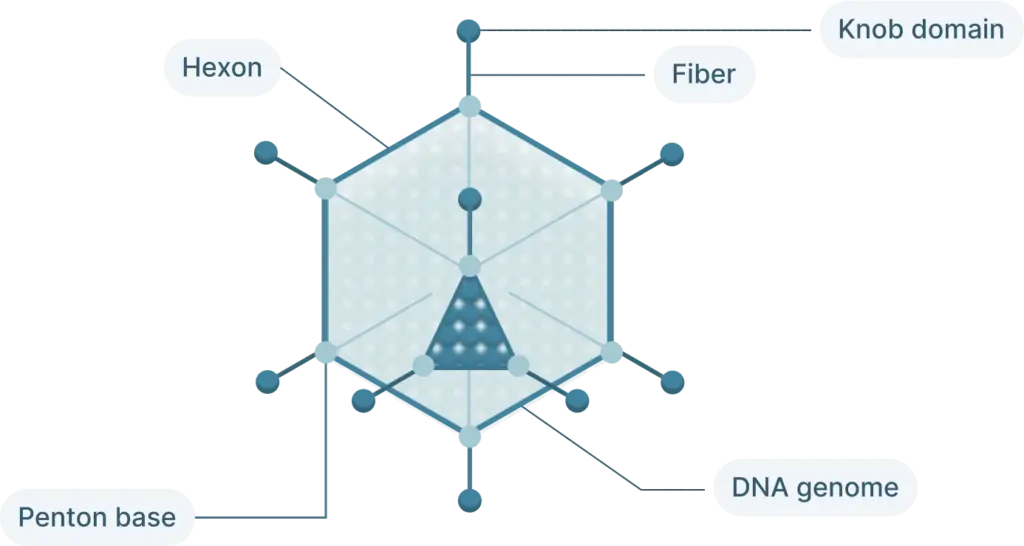
The adenovirus capsid is a non-enveloped icosahedral protein shell of approximately 70–90 nm in diameter, built from three major capsid proteins — hexon, penton base, and fiber — together with the minor proteins IIIa, VI, VIII, and IX (Figure 5). The 240 hexon trimers form the 20 triangular facets of the icosahedron, while 12 penton complexes occupy each vertex; each penton consists of a penton base anchored in the capsid and a trimeric fiber projecting outward. The fiber knob mediates initial attachment to host cell receptors, and the penton base then engages cellular integrins to drive internalization.
More than 50 human adenovirus serotypes have been characterized and are organized into seven species (A–G) based on hemagglutination, sequence homology, and receptor usage. Serotype determines tropism and primary receptor:
- Species C (e.g., Ad2, Ad5): bind the coxsackievirus and adenovirus receptor (CAR); broad tropism with strong transduction of liver and many epithelial cell types. Ad5 is the most widely used backbone in research and gene-delivery applications.
- Species B (e.g., Ad3, Ad11, Ad35): use CD46 as the primary receptor, giving access to cell types that express low levels of CAR.
- Species D: several members use sialic acid; some serotypes are associated with ocular tropism.
The replication-defective recombinant adenoviruses used as research vectors are typically derived from Ad5, with E1 (and often E3) deleted to render the virus non-replicative and to create space for transgene insertion.
What is this product?
Ad-DIO-GCaMP6s is a replication-defective recombinant human adenovirus type 5 (Ad5) expressing DIO-GCaMP6s under the CMV promoter. The vector backbone has E1 and E3 deleted, rendering it non-replicative and accommodating the transgene cassette.
How should I store and handle the virus?
Stocks are supplied at 1×10¹⁰ PFU/ml in storage buffer (typically 10 mM Tris pH 8.0, 2 mM MgCl2, 4% sucrose or similar). Store at −80 °C upon receipt, and aliquot before first use to minimize freeze-thaw cycles — recombinant adenovirus loses ~10–20% of infectious titer per freeze-thaw and should be limited to ≤3 cycles for quantitative work. Thaw on ice and dilute into pre-warmed culture medium immediately before infection.
Biosafety: Replication-defective Ad5 vectors are typically handled at BSL-2; consult your institutional biosafety officer for the specific transgene and route of use.
What MOI should I start with?
Optimal MOI varies by cell type, but useful starting ranges are:
- Most cell lines (HEK293, HeLa, U2OS, HepG2, etc.): MOI 10–100
- Primary cells (hepatocytes, cardiomyocytes, fibroblasts): MOI 50–500
- Resistant or low-CAR cells (some lymphocytes, hematopoietic): MOI 500–2000 (may give limited transduction; consider Ad5/35 fiber modification if available)
Worked example. To infect 1×10⁶ cells at MOI 100 from a 1×10¹⁰ PFU/ml stock: PFU needed = 100 × 106 = 1×10⁸ PFU; volume needed = 10 µl of stock. Always run a 3–5× MOI titration in your specific cell model to identify the dose that gives near-100% transduction without cytopathic effect.
When can I expect expression / activity?
Transgene expression is typically detectable within 24 hours post-infection, peaks at 48–72 hours, and remains elevated for 1–2 weeks in dividing cells (the episomal Ad genome dilutes with cell division). In non-dividing cells (hepatocytes, neurons, cardiomyocytes), expression can persist for several weeks. Plan endpoint assays around the 48–72 hour window for peak expression.
What controls should I run?
For over-expression experiments, include:
- Ad-CMV-Null or Ad-Blank — capsid/dose control without transgene.
- Ad-CMV-GFP or Ad-CMV-LacZ at matched MOI — transduction-load control to match for the burden of expressing a transgene.
- Untransduced cells — baseline target gene/protein expression.
Confirm transgene expression by Western blot or immunofluorescence at the same time point as your endpoint assay.
Can't find the adenovirus you need—or require a custom design and packaging service? We offer end-to-end adenoviral support for diverse research needs, including vector design and cloning, adenovirus construction for over-expression (from your plasmid, sequence, or RefSeq#), shRNA-silencing adenoviruses (from a working shRNA or via shRNA screening when you only have the target gene), and gRNA adenoviruses (from a gRNA cassette or sequence). Custom plasmid construction typically takes ~2 weeks, with viral packaging, purification, and QC adding another 2–4 weeks. Final stocks are CsCl-purified and PFU-titered, with deliverables of approximately 1×10¹² viral particles (1×10¹⁰–1×10¹¹ PFU). We also provide amplification and CsCl purification services at medium scale (~1×10¹⁰–5×10¹⁰ PFU/IFU in 2 mL, ~2 weeks; ideal for in vitro studies) and large scale (5×10¹²–1×10¹³ viral particles / 1–3×10¹¹ PFU, ~2–3 weeks; ideal for in vivo studies) — including amplification of customer-supplied viral stocks. Click Talk to a Scientist to submit a request, email us at support@biohippo.com, or explore our Research Services for additional support. Our team will be in contact with you shortly.

