

| Field | Specification |
|---|---|
| Applications | |
| Source | Recombinant (E. coli) |
| Storage | |
| Shipping | |
| Catalog no. (Mfr.) | |
| Main SKU |
DNase I is an endonuclease that can digest single-stranded and double-stranded DNA to produce single deoxynucleotides or single-stranded or double-stranded oligodeoxynucleotides. It can hydrolyze the phosphodiester bond to produce monodeoxynucleotides and oligodeoxynucleotides containing 5'-phosphate groups and 3'-OH groups. The average digestion product is the smallest polytetranucleotide. DNase I can catalyze many forms of DNA, such as single-stranded DNA, double-stranded DNA, and even chromatin (its cutting rate is affected by histones). The optimum pH range is 7-8. The activity of DNase I depends on Ca2+ and can be activated by divalent metal ions, such as Co2+, Mn2+, Zn2+, etc. 5 mM Ca2+ can protect the enzyme from being hydrolyzed. In the presence of Mg2+, the enzyme can recognize and cut any site on any strand of DNA randomly; and in the presence of Mn2+, it can recognize two strands of DNA at the same time and cut at almost the same site to form blunt ends, Or sticky ends with 1-2 nucleotides protruding. DNase I is widely used in the preparation of DNA-free RNA; remove the template DNA after in vitro transcription; prepare DNA-free RNA before RT-PCR and RT-qPCR reactions; combine with DNA polymerase I to perform DNA labeling through nick translocation; DNA fragmentation library construction.
This product is produced in accordance with GMP process requirements, and the product is provided in liquid form.
Feature
- DNA specific Endonuclease
- Degrades double-stranded and single-stranded DNA
- Products are short oligos with 5'-phosphate and 3'-OH
Application
- Removal of contaminating genomic DNA from RNA samples
- Degradation of DNA templates in transcription reactions
Specification
| Source | Recombinant E. coli with DNase I gene |
| Optimum temperature | 37℃ |
| Storage Buffer | 10 mM Tris-HCl pH 7.6,2 mM CaCl2, 50% (v/v) Glycerol |
| Unit Definition | The amount of enzyme required to completely degrade 1 μg of plasmid DNA within 10 min at 37°C. (The reaction buffer is: 10 mM Tris-HCl pH 7.6, 2.5 mM MgCl2, 0.5 mM CaCl2, 1 μg plasmid DNA) |
Components
| Components No. | Name | 10611ES76 (500 U) | 10611ES84 (2,000 U) | 10611ES92 (10,000 U) |
| 10611 | Deoxyribonuclease I (DNase I) GMP-grade (2 U/μL) | 250 μL | 1 mL | 5 mL |
Shipping and Storage
Deoxyribonuclease I (DNase I) GMP-grade products are shipped with dry ice and can be stored at -15℃ ~ -25℃ for one year.
Figures
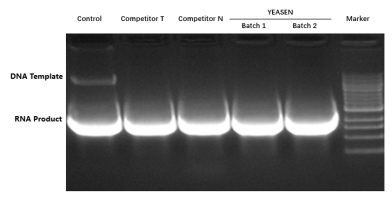
Figure 1. DNase I from YEASEN could effectively remove DNA template during transcription,compared with competitor brands.

[1] Lu Z, Liu H, Song N, et al. METTL14 aggravates podocyte injury and glomerulopathy progression through N6-methyladenosine-dependent downregulating of Sirt1. Cell Death Dis. 2021;12(10):881. Published 2021 Sep 27. doi:10.1038/s41419-021-04156-y(IF:8.469)
[2] Yu Y, Wang Y, Zhang W, et al. Biomimetic periosteum-bone substitute composed of preosteoblast-derived matrix and hydrogel for large segmental bone defect repair. Acta Biomater. 2020;113:317-327. doi:10.1016/j.actbio.2020.06.030(IF:7.242)
Glycerol Content: Contains Glycerol
Store this enzyme at -20°C and avoid repeated freeze-thaw cycles to preserve catalytic activity. The product is shipped Dry Ice and remains stable for up to one year from the date of manufacture when stored under recommended conditions. Aliquoting the stock solution into single-use volumes is recommended for enzymes used infrequently to minimize thermal cycling of the bulk stock.
This enzyme is validated for use in Nucleic Acid Purification applications. It is suitable for use in both standard laboratory research settings and, where applicable, optimized reaction workflows requiring high specificity, sensitivity, or throughput.
One unit (U) is defined as the amount of enzyme that degrades 1 µg of DNA or RNA substrate to acid-soluble form in 30 min at 37°C under defined buffer conditions.
This enzyme is produced as Recombinant (E. coli) and is available in GMP grade for regulated applications. This enzyme is manufactured in an ISO 13485-certified UCF.ME™ facility and meets GMP-grade quality standards. Each lot is subjected to activity assay, purity assessment by SDS-PAGE, and functional validation prior to release. A Certificate of Analysis (CoA) and Safety Data Sheet (SDS) are available on request.
Nuclease activity typically requires divalent metal ion cofactors (Mg²⁺ or Mn²⁺ at 1–5 mM). Activity is inhibited by chelating agents such as EDTA (≥1 mM), high salt concentrations, and reducing agents such as DTT at elevated concentrations. Heat inactivation (65–75°C for 15 min) is effective for most nucleases, allowing removal of enzyme activity after digestion without column purification.
Yeasen Biotechnology supports custom enzyme solutions across multiple service lines — from GMP-grade bulk supply to directed enzyme engineering. Contact BioHippo to discuss requirements and initiate a project inquiry.
▶ GMP-Grade & Bulk Supply
Select Yeasen enzymes are available in GMP grade, manufactured in an ISO 13485-certified UCF.ME™ ultra-clean molecular enzyme facility with FDA Drug Master File (DMF) support.
- GMP-grade release testing and CoA documentation
- ISO 13485-certified production facility
- Scalable from milligram to multi-gram quantities
- Consistent lot-to-lot activity specifications
▶ Glycerol-Free & Custom Formulation
Glycerol-free enzyme formats are available for applications requiring lyophilization compatibility, liquid handling automation, or direct IVD master mix integration.
- Glycerol-free liquid format (standard and custom buffers)
- Lyophilization-ready enzyme preparation
- Custom reaction buffer optimization for specific assay conditions
- Compatible with freeze-drying workflows for point-of-care formats
▶ Molecular IVD RDC Service
Yeasen's Research and Development Contracting (RDC) team delivers end-to-end solutions for molecular diagnostic product development, covering enzyme selection through clinical validation support.
- Enzyme selection and performance matching
- Primer/probe design and reaction buffer optimization
- Sensitivity, specificity, and precision validation studies
- Stability studies and SNP evaluation
- Instrument platform compatibility assessment
▶ ZymeEditor™ Enzyme Engineering
Yeasen's proprietary ZymeEditor™ directed evolution and rational design platform enables the development of custom enzyme variants with tailored performance characteristics not available in off-the-shelf products.
- Directed evolution for enhanced thermostability, processivity, or fidelity
- Rational design for altered substrate specificity or cofactor requirements
- Library screening from Yeasen's proprietary enzyme variant collection
- Scale-up to commercial quantities upon candidate confirmation
ⓘ Customization services are fulfilled by Yeasen Biotechnology. Lead times and minimum order quantities vary by service type. Contact BioHippo for project scoping and pricing.
- Lu Z, Liu H, Song N, et al. METTL14 aggravates podocyte injury and glomerulopathy progression through N6-methyladenosine-dependent downregulating of Sirt1. Cell Death Dis. 2021;12(10):881. Published 2021 Sep 27. doi:10.1038/s41419-021-04156-y(IF:8.469)
- Yu Y, Wang Y, Zhang W, et al. Biomimetic periosteum-bone substitute composed of preosteoblast-derived matrix and hydrogel for large segmental bone defect repair. Acta Biomater. 2020;113:317-327. doi:10.1016/j.actbio.2020.06.030(IF:7.242)
- COA
DNase I Demystified | How to break through the bottleneck of traditional technology by expressing DNase I in yeast
DNase I Applications

