


Denarase® High Salt – Salt-Tolerant Nuclease for High-Efficiency DNA Removal
Denarase® High Salt is designed to retain activity at elevated salt and different pH levels. It is specifically engineered for use in development and manufacturing processes that benefit from salt additions. The salt-tolerant enzyme efficiently cleaves all forms of DNA and RNA across a broad range of process-relevant conditions, facilitating flexible and more efficient production of biologicals, such as viral vectors and vaccines. Denarase® High Salt GMP-grade manufacturing complies with EU GMP standards Denarase® High Salt R&D-grade is produced under ISO 9001 standard Both quality grades of Denarase® High Salt are technically equivalent, enabling a seamless transition from early R&D stages to biopharmaceutical manufacturing under GMP
| Catalog No. | Size | Quality Grade | Availability | Price | Qty | Order |
|---|---|---|---|---|---|---|
| 22002-25k | 25 kU | R&D | In Stock | $363.00 |
|
|
| 22002-100k | 100 kU | R&D | In Stock | $913.00 |
|
|
| 22002-500k | 500 kU | R&D | In Stock | $2,744.50 |
|
|
| 22002-1000k | 1000 kU | R&D | In Stock | $4,015.00 |
|
|
| 22002-5000k | 5000 kU | R&D | In Stock | $13,579.50 |
|
|
| 22002-1M | 1 MU | GMP | In Stock at Manufacturer | $4,767.00 |
|
|
| 22002-5M | 5 MU | GMP | In Stock at Manufacturer | $15,956.00 |
|
Choose Size, then Quality Grade.
Overview
What is Denarase® High Salt – Salt-Tolerant Nuclease for High-Efficiency DNA Removal?
About Denarase® High Salt
How Denarase® High Salt works
Denarase® High Salt is an engineered version of the wild-type Serratia marcescens endonuclease. By introducing a few targeted amino acid substitutions, the enzyme was optimized for salt tolerance, retaining activity at higher salt concentrations without losing specificity for nucleic acids. Denarase® High Salt exhibits high DNA removal activity across a broad range of salt concentrations (0–500 mM NaCl) and pH levels, providing greater flexibility in bioprocessing and enabling seamless integration into existing workflows.
Production of Denarase® High Salt
Denarase® High Salt is produced using a method nearly identical to the established, patented Denarase® manufacturing process, based on expression in a gram-positive Bacillus sp. strain. Developed for commercial production of biologicals, the enzyme is manufactured under GMP conditions complying with EU GMP regulations. Produced without antibiotics, Triton X-100, animal-derived or TSE/BSE risk raw materials.
Denarase® High Salt is available in two quality grades
Denarase® High Salt for Research and Development (R&D) use & Denarase® High Salt for manufacturing under GMP.
- Denarase® High Salt R&D-grade: produced under ISO 9001 standard; less stringent requirements for documentation, storage, and distribution.
- Denarase® High Salt GMP-grade: manufactured under EU GMP conditions, with regulatory documentation available on request.
- Both quality grades are technically equivalent, enabling a seamless transition from R&D to GMP manufacturing.
Details
Specifications
Evidence
Validation & QC · lot-released against spec
Release metrics and QC figures are provided per lot; full numeric values are on the lot-specific CoA.
Manufacturing
How it's made & quality control
Supplier quality control
Batch release specification
\nAppearance: clear, transparent solution. Activity above 250 U/µL by photometric assay. Purity ≥ 99% (standard Denarase®) or ≥ 98% (Denarase® High Salt) by SDS-PAGE with silver staining. Specific activity above 6 × 10⁵ U/mg for standard Denarase® and at least 4 × 10⁵ U/mg for Denarase® High Salt. No protease activity detectable (standard Denarase® release specification). Endotoxin below 0.25 EU/kU by LAL per Ph. Eur. 2.6.14 Method C. Microbial count per Ph. Eur. 2.6.12: aerobic bacteria and yeast or moulds each below 5 cfu per 200 µL.
Clearance validation
\nThe Denarase® ELISA Kit is a monoclonal antibody-based sandwich ELISA for residual Serratia marcescens endonuclease in process samples, covering standard Denarase®, Denarase® High Salt and Benzonase®. Limit of detection 4 pg/mL, limit of quantification 12 pg/mL, working range approximately 32–1,000 pg/mL, assay time approximately 130 minutes. For High Salt, apply a correction factor of 1.46. Benzonase® is a registered trademark of Merck KGaA.
Documents available
\nProduct Information Sheets and Product Specifications for R&D and GMP grades; Validation Guide; guidance on qualifying Denarase® in biopharmaceutical manufacturing; Change Guidance Document for grade transition; ELISA Kit user instructions, kit contents and prevalidation report.
Supplier-level quality statement. For lot-specific results, request the Certificate of Analysis for your batch.
Resources
Documents & downloads
Questions
Frequently asked questions
What is the difference between Denarase® and Denarase® High Salt?
Denarase® High Salt is an engineered variant of the standard enzyme. A few targeted amino acid substitutions increase salt tolerance without affecting nucleic acid specificity.
Will Denarase® High Salt replace the standard Denarase® product?
No. Both products address distinct application needs and will continue to co-exist in the portfolio. The standard enzyme remains the more economical choice below 150 mM salt.
What is the delivery time for Denarase® High Salt?
R&D grade is held in US stock and ships in 2–3 business days. GMP grade is held at the manufacturer, typically 1–2 weeks.
For which salt concentrations is Denarase® High Salt recommended?
Above 150 mM NaCl as a general rule. Between 150 and 250 mM, test both enzymes — pH and magnesium concentration also influence activity in this range.
What are the recommended usage conditions?
Recommended for processes above 150 mM NaCl. Magnesium must be raised to at least 5 mM, with a working range of 5–25 mM depending on NaCl and pH; 15 mM is a reasonable starting point for initial tests. Typical starting enzyme concentration is 10–100 U/mL.
Note that the release assay is run at 250 mM NaCl and 5 mM MgCl2, so activity units are not directly comparable to standard Denarase®. Generate a process-specific activity profile rather than converting between the two.
What can Denarase® High Salt be used for?
It hydrolyses phosphodiester bonds, leaving fragments of roughly 3–5 base pairs, and is active on all nucleic acid forms — single- and double-stranded, linear, circular and supercoiled. The engineered salt tolerance suits bioprocess steps run at elevated ionic strength.
What are the main application fields?
Viral vector production (AAV, lentivirus, HEK293): used during or after cell lysis in high-salt buffer to reduce viscosity and simplify purification.
Vaccine manufacturing (live attenuated, inactivated, VLP): reduces host cell DNA under elevated ionic strength and improves process robustness.
Are there different quality grades?
Two grades, technically equivalent and released against the same specification parameters. R&D grade is produced under ISO 9001 with less strict documentation, storage and distribution requirements. GMP grade is manufactured under EU GMP with GDP-compliant distribution.
Can the Denarase® ELISA Kit quantify Denarase® High Salt?
Yes, but the kit standard is calibrated against standard Denarase®, so a correction factor of 1.46 must be applied. Alternatively, generate a separate Denarase® High Salt standard curve. The kit detects residual enzyme down to a limit of quantification of 12 pg/mL.
How can Denarase® High Salt be removed from my process?
Anion exchange, cation exchange, hydrophobic interaction, hydroxyapatite or size exclusion chromatography, and filtration techniques. Media selection should be evaluated case by case.
How can enzyme activity be inhibited?
NaCl above 1 M is required for inactivation, compared with roughly 600 mM for standard Denarase®. Potassium phosphate at 200–300 mM also quenches activity, and EDTA above 5 mM inhibits the reaction by removing free magnesium ions.
Are Denarase® High Salt products tested for endotoxins?
Yes. Every batch must meet the endotoxin specification of less than 0.25 EU/kU before release, tested by LAL assay according to Ph. Eur. 2.6.14 / USP <85> Method C. See the Validation Guide for full details.
How does Denarase® High Salt compare with other salt-active endonucleases?
Kerry (formerly c-LEcta) has published comparative data covering the development of Denarase® High Salt and its performance against other commercially available salt-tolerant endonucleases for viral vector manufacturing. Available on request.
Answered by our team
Questions from researchers
No researcher questions have been answered for this product yet. Ask our technical team and we'll get back to you — approved answers are published here.
Ask our technical team
Reviewed by a scientist — typically answered within one business day.
Deals
Promotions
Codes apply at checkoutReferences
Citations & references
A selection of peer-reviewed publications and reports referencing or featuring DENARASE®.
Viral Vectors for Gene Therapy and Vaccine Production
22 publicationsProduction of Virus-like Particles (VLP)
10 publicationsProduction of Bacteriophages
2 publicationsBiofilm Removal
2 publicationsProtein Purification
5 publicationsIn the literature
Research using this product
Every paper below mentions this product's catalogue number (or product name) in its full text — a text match, not a verified citation. Each entry shows what was measured, the sample type where the paper states it, and the sentence the catalogue number appears in, and a link to the figure showing that data — so you can confirm the use case before citing.
Auto-discovered from Europe PMC by manufacturer number / product name / keyword plus supplier. A match may reference a related product; confirm relevance before citing.
Customization
Customization & add-ons
Explore
Collections featuring this product
This product is included in the curated collections below. Browse a collection to source everything for a workflow from a single cart.
From the blog
Related articles & guides
 Comparison GuideLosing CD Markers After Dissociation? How Enzyme Choice Affects Surface EpitopesWhy surface markers disappear after enzymatic dissociation, what the published comparisons actually measured, and how to separate an epitope artefact...
9 min read· Sep 2026
Comparison GuideLosing CD Markers After Dissociation? How Enzyme Choice Affects Surface EpitopesWhy surface markers disappear after enzymatic dissociation, what the published comparisons actually measured, and how to separate an epitope artefact...
9 min read· Sep 2026
 ProtocolPreparing High-Viability Single-Cell Suspensions for scRNA-seqA reagent-neutral protocol for preparing a high-viability single-cell suspension for scRNA-seq: dissociation timing judged by microscope, cold versus warm digestion,...
12 min read· Sep 2026
ProtocolPreparing High-Viability Single-Cell Suspensions for scRNA-seqA reagent-neutral protocol for preparing a high-viability single-cell suspension for scRNA-seq: dissociation timing judged by microscope, cold versus warm digestion,...
12 min read· Sep 2026
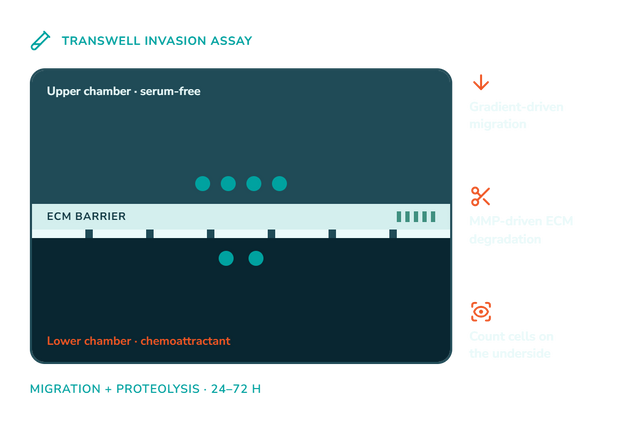 Application NoteInvasion Assays: A Step-by-Step Experimental WorkflowHow to plan, run and quantify in vitro cell migration and invasion assays: choosing between scratch, chemotaxis, transwell invasion and...
12 min read· Sep 2026
Application NoteInvasion Assays: A Step-by-Step Experimental WorkflowHow to plan, run and quantify in vitro cell migration and invasion assays: choosing between scratch, chemotaxis, transwell invasion and...
12 min read· Sep 2026
 ProtocolGentle Dissociation of Neurons and NeurospheresA reagent-neutral protocol for neuron and neurosphere dissociation: choosing between mechanical and enzymatic passaging, controlling trituration shear, DNase I, debris...
12 min read· Sep 2026
ProtocolGentle Dissociation of Neurons and NeurospheresA reagent-neutral protocol for neuron and neurosphere dissociation: choosing between mechanical and enzymatic passaging, controlling trituration shear, DNase I, debris...
12 min read· Sep 2026
Recently viewed
Recently viewed products
Try Celltrypse Free – Request Your Sample Today
Experience the power of Celltrypse™, c-LEcta's innovative enzyme solution for gentle and efficient cell dissociation. Request your free sample and discover a superior alternative for your cell culture workflows.

Try Celltrypse Free – Request Your Sample Today
Experience the power of Celltrypse™, c-LEcta's innovative enzyme solution for gentle and efficient cell dissociation. Request your free sample and discover a superior alternative for your cell culture workflows.
