

| Field | Specification |
|---|---|
| Applications | |
| Source | Recombinant (E. coli) |
| Storage | |
| Shipping | |
| Catalog no. (Mfr.) | |
| Main SKU |
This product is an inorganic pyrophosphatase derived from recombinant expression in Escherichia coli. It is an enzyme that can catalyze the conversion of one molecule of pyrophosphate into two molecules of phosphate ions. This is a high-energy reaction, so this reaction can be coupled to some thermodynamically unfavorable transformations in order to drive these transformations to completion. Inorganic pyrophosphatase (PPase) catalyzes the hydrolysis of inorganic pyrophosphate to orthophosphate. In molecular biology, it can be used to increase RNA yield in reverse transcription reactions. This product is produced in accordance with GMP process requirements, and the product is provided in liquid form.
Feature
- Isolated from a recombinant source
- Tested for the absence of endonucleases, exonucleases, RNases
- Increasing RNA yield in transcription reaction; enhancing DNA replication
Application
- DNA sequencing reaction
- PCR and single-base extension reaction
- In vitro transcription processes
Specification
| Source | Recombinant E.coli with Pyrophosphatase gene from yeast |
| Optimum Temperature | 25℃ |
| Storage Buffer | 50 mM Tris-HCl pH 7.9,100 mM NaCl,10 mM DTT,1 mM EDTA,0.1% (v/v)TritonX-100,50%(v/v)glycerin |
| Unit Definition | One unit (U) is the amount of enzyme needed to catalyze the hydrolysis of PPI per minute to produce 1 μmol Pi. (The standard reaction is: 500 μL system contains 100 mM Tris-HCl pH7.2, 2 mM MgCl2, 2 mM Ppi; reaction at 25℃ for 10 min) |
Components
| Components No. | Name | 10620ES10 (10 U) | 10620ES60 (100 U) | 10620ES80 (1,000 U) | 10620ES99 (40 KU) |
| 10620 | Pyrophosphatase, Inorganic GMP-grade (1 U/μL) | 10 μL | 100 μL | 1 mL | 40 mL |
Shipping and Storage
The Pyrophosphatase, Inorganic GMP-grade products are shipped with dry ice and can be stored at -15℃ ~ -25℃ for one year.
Figures
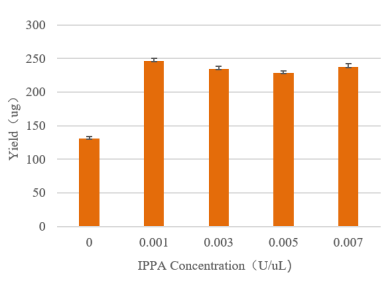
Figures 1. The relationship between RNA yield and IPPA concentration in vitro transcription
Glycerol Content: Contains Glycerol
Store this enzyme at -20°C and avoid repeated freeze-thaw cycles to preserve catalytic activity. The product is shipped Dry Ice and remains stable for up to one year from the date of manufacture when stored under recommended conditions. Aliquoting the stock solution into single-use volumes is recommended for enzymes used infrequently to minimize thermal cycling of the bulk stock.
This enzyme is validated for use in NGS Library Preparation, Cloning & Assembly applications. It is suitable for use in both standard laboratory research settings and, where applicable, optimized reaction workflows requiring high specificity, sensitivity, or throughput.
One unit (U) is defined as the amount of enzyme that catalyzes the phosphorylation or dephosphorylation of 1 nmol of substrate per minute at 37°C under standard buffer conditions.
This enzyme is produced as Recombinant (E. coli) and is available in GMP grade for regulated applications. This enzyme is manufactured in an ISO 13485-certified UCF.ME™ facility and meets GMP-grade quality standards. Each lot is subjected to activity assay, purity assessment by SDS-PAGE, and functional validation prior to release. A Certificate of Analysis (CoA) and Safety Data Sheet (SDS) are available on request.
T4 Polynucleotide Kinase (T4 PNK) catalyzes the transfer of a γ-phosphate from ATP to the 5′-hydroxyl terminus of DNA or RNA, enabling ligation of blunt-end or cohesive-end fragments lacking 5′ phosphates. Shrimp Alkaline Phosphatase (SAP) removes 5′ and 3′ phosphate groups from DNA, RNA, and dNTPs, and is heat-inactivated at 65°C for 15 min—eliminating the need for column cleanup prior to downstream reactions.
Yeasen Biotechnology supports custom enzyme solutions across multiple service lines — from GMP-grade bulk supply to directed enzyme engineering. Contact BioHippo to discuss requirements and initiate a project inquiry.
▶ GMP-Grade & Bulk Supply
Select Yeasen enzymes are available in GMP grade, manufactured in an ISO 13485-certified UCF.ME™ ultra-clean molecular enzyme facility with FDA Drug Master File (DMF) support.
- GMP-grade release testing and CoA documentation
- ISO 13485-certified production facility
- Scalable from milligram to multi-gram quantities
- Consistent lot-to-lot activity specifications
▶ Glycerol-Free & Custom Formulation
Glycerol-free enzyme formats are available for applications requiring lyophilization compatibility, liquid handling automation, or direct IVD master mix integration.
- Glycerol-free liquid format (standard and custom buffers)
- Lyophilization-ready enzyme preparation
- Custom reaction buffer optimization for specific assay conditions
- Compatible with freeze-drying workflows for point-of-care formats
▶ Molecular IVD RDC Service
Yeasen's Research and Development Contracting (RDC) team delivers end-to-end solutions for molecular diagnostic product development, covering enzyme selection through clinical validation support.
- Enzyme selection and performance matching
- Primer/probe design and reaction buffer optimization
- Sensitivity, specificity, and precision validation studies
- Stability studies and SNP evaluation
- Instrument platform compatibility assessment
▶ ZymeEditor™ Enzyme Engineering
Yeasen's proprietary ZymeEditor™ directed evolution and rational design platform enables the development of custom enzyme variants with tailored performance characteristics not available in off-the-shelf products.
- Directed evolution for enhanced thermostability, processivity, or fidelity
- Rational design for altered substrate specificity or cofactor requirements
- Library screening from Yeasen's proprietary enzyme variant collection
- Scale-up to commercial quantities upon candidate confirmation
ⓘ Customization services are fulfilled by Yeasen Biotechnology. Lead times and minimum order quantities vary by service type. Contact BioHippo for project scoping and pricing.
- Li Q, You J, Qiao T, Zhong DB, Yu X. Sodium chloride stimulates the biomass and astaxanthin production by Haematococcus pluvialis via a two-stage cultivation strategy. Bioresour Technol. 2022;344(Pt A):126214. doi:10.1016/j.biortech.2021.126214(IF:9.642)
- Ma Y, Cheng B, Li Y, et al. Protective Effect of Nanoselenium on Renal Oxidative Damage Induced by Mercury in Laying Hens. Biol Trace Elem Res. 2022;200(8):3785-3797. doi:10.1007/s12011-021-02956-z(IF:3.738)
DNase I Applications

