

BeaverBeads Magrose NHS as supplied. The bottle shown is labelled Cat. No. 70702-5, 20% (v/v), 5 mL, store at 2-8 C. The beads are supplied in anhydrous isopropyl alcohol to keep the NHS esters from hydrolysing.

BeaverBeads Magrose NHS Pre-Activated Magnetic Agarose Beads
NHS pre-activated superparamagnetic agarose beads (30-150 um) carrying 20-30 umol of N-hydroxysuccinimide ester per mL of beads. Couples amine-bearing ligands directly in 1-2 hours with no EDC or glutaraldehyde activation step, at over 90% efficiency, binding 20-30 mg of rabbit IgG per mL of beads.
| Catalog No. | Size | Availability | Price | Qty | Order |
|---|---|---|---|---|---|
| 70702-1 | 1 mL | In Stock at Manufacturer | $1,080.00 |
|
|
| 70702-5 | 5 mL | In Stock at Manufacturer | $3,280.00 |
|
|
| 70702-50 | 50 mL | In Stock at Manufacturer | $16,800.00 |
|
|
| 70702-1000 | 1000 mL - price on request | Made to Order | Quote | — | |
| 70702 | Other size - enquire | Made to Order | Quote | — |
Choose Size.
Overview
What is BeaverBeads Magrose NHS Pre-Activated Magnetic Agarose Beads?
Product Overview
BeaverBeads™ Magrose NHS are superparamagnetic agarose microspheres whose surface is already activated with N-hydroxysuccinimide esters. NHS esters react directly with primary amines to form stable amide bonds, so any ligand carrying an accessible amine — antigen, antibody, protein, peptide or amine-modified oligonucleotide — can be immobilised without an activation step of your own.
That is the practical difference from carboxyl or amino beads. There is no EDC/NHS activation and no glutaraldehyde chemistry to run first, and no window in which activated beads have to be used before they hydrolyse. You dissolve the ligand in an amine-free coupling buffer, mix with the beads for 1–2 hours at room temperature or 4 °C, block, and you are done.
Specification
Ligand density is 20–30 µmol of NHS per mL of beads, and the manufacturer quotes a binding capacity of 20–30 mg of rabbit IgG per mL of beads — a reference figure, since capacity depends on the ligand. Coupling efficiency is stated at over 90% under optimised conditions, in 1–2 hours, at pH 5–9 and either room temperature or 4 °C. Note the 20% (v/v) suspension: 1 mL of what you pipette contains 200 µL of beads.
Coupling in outline
Prepare the protein solution in an amine-free buffer; wash the beads quickly with cold wash buffer; couple the protein; block residual NHS groups; wash into storage buffer. Blocking uses the 3 M ethanolamine supplied in the kit format, or 100 mM Tris-HCl with 150 mM NaCl at pH 8.0. After coupling, the bead concentration is 10% (v/v). Two optimisations matter: the choice of coupling buffer (coupling buffer A or B, 50 mM boric acid, 100 mM NaCl pH 7.4 are the candidates BEAVER lists), and the protein concentration — higher concentration couples more protein because NHS coupling competes with NHS hydrolysis, so it is a cost-versus-loading decision.
Applications
In vitro diagnostics and immunoassay development, immunoprecipitation and co-immunoprecipitation, cell sorting, and isolation and purification of proteins and antibodies.
Critical handling notes
The beads are water-sensitive. NHS esters hydrolyse on contact with water, which is why the wash step must be fast and use chilled buffer. Reseal the bottle immediately after sampling, tape the cap, and store at 4 °C.
The coupling buffer must contain no free amine. Any primary amine in the buffer competes with your ligand and consumes the activated sites.
Do not quantify coupled protein at 280 nm. NHS groups absorb strongly near 280 nm and will seriously distort the reading. Use a colorimetric assay instead — BEAVER cites the Pierce 660 nm protein assay or micro BCA.
Protein stabilisers block coupling. BSA and gelatin in an antibody preparation will compete for the NHS sites. Buffer-exchange the antibody before coupling.
Do not dry or freeze the beads; both cause aggregation and loss of binding activity. A magnetic separator is required. Keep beads and separators away from metal objects, electronic devices and implanted electronic devices such as cardiac pacemakers.
For Research Use Only. Not for use in diagnostic or therapeutic procedures. Specifications are those published by the manufacturer, BEAVER Biomedical Engineering Co., Ltd.
Details
Specifications
Applications
Applications & how to use
Immunoprecipitation (IP)
Enriches a target protein and its interacting partners from lysate using an antibody coupled to beads. Used for interaction studies and downstream WB or MS.
Protein Purification
Separating a target protein from a complex mixture while keeping it folded and active, using chromatography, spin columns, selective binding or buffer exchange. Recovery and retained activity matter more than purity alone, so an activity assay should accompany the gel at each step.
Bioconjugation
Covalent attachment of a biological ligand — antibody, protein, peptide or oligonucleotide — to a surface or another molecule. The chemistry chosen determines orientation and retained activity, so coupling through a residue distant from the binding site usually matters more than raw coupling efficiency.
Chemiluminescence Immunoassay (CLIA)
Immunoassay read by light emitted from an enzymatic or direct chemiluminescent label, giving wider dynamic range and lower detection limits than colorimetric ELISA. Magnetic microspheres are the usual solid phase, so bead uniformity and low non-specific binding translate directly into assay sensitivity and reproducibility.
Cell Separation
Isolation of a defined cell population from a mixed suspension, most often by antibody-coated magnetic beads in positive or negative selection format. Negative selection leaves the target untouched by antibody, which is preferred when downstream function or receptor availability could be affected by bead binding.
Evidence
Validation & QC
Validation data for this product isn’t published yet.
Need specific QC or validation results — titer, purity, endotoxin, or assay data — for your application? Our scientific team can share what is available for this product and lot on request.
Request validation dataManufacturing
How it's made & quality control
Supplier quality control
Magnetic and functionalized beads are QC-tested for size uniformity, binding capacity and lot-to-lot consistency for reproducible separation and purification.
Product sheets provide bead size, surface chemistry, binding capacity and recommended protocols.
Certificate of Analysis provided per lot with binding-capacity data.
Supplier-level quality statement. For lot-specific results, request the Certificate of Analysis for your batch.
Questions
Frequently asked questions
Why use NHS beads instead of COOH beads?
You skip the activation step. With carboxyl beads you must activate with EDC and NHS yourself, work fast before the activated esters hydrolyse, and manage a two-buffer, two-pH workflow. NHS beads arrive activated: dissolve your ligand in an amine-free buffer, mix for 1-2 hours, block. Fewer steps means fewer places for the coupling to fail.
Why is the product supplied in isopropyl alcohol?
Because NHS esters hydrolyse in water. The anhydrous solvent keeps the activated groups intact on the shelf. This is also why the wash step before coupling must be quick and use chilled buffer, and why you should reseal and tape the bottle immediately after sampling.
What buffer should I couple in?
Anything without a free primary amine - a free amine competes directly with your ligand for the activated sites. BEAVER lists coupling buffer A, coupling buffer B, and 50 mM boric acid with 100 mM NaCl at pH 7.4 as candidates. Screening the buffer is the first optimisation.
How much protein should I load?
More protein couples more protein, because NHS coupling competes with NHS hydrolysis - the faster your ligand reaches the surface, the less is lost to water. So the answer is a cost decision, not a chemistry one. If you only need light loading, use a low concentration and accept the loss.
How do I measure how much protein coupled?
Not at 280 nm. NHS groups absorb strongly around 280 nm and will wreck the reading. Use a colorimetric assay - BEAVER cites the Pierce 660 nm protein assay or the micro BCA assay - on the solution before and after coupling.
My antibody stock contains BSA. Is that a problem?
Yes. BSA and gelatin stabilisers carry plenty of primary amines and will consume NHS sites that should have gone to your antibody. Buffer-exchange or purify the antibody away from stabiliser before coupling.
What should I block with?
3 M ethanolamine, which is supplied in the kit format, or 100 mM Tris-HCl with 150 mM NaCl at pH 8.0. Both quench residual NHS esters so they cannot capture sample protein later.
Answered by our team
Questions from researchers
No researcher questions have been answered for this product yet. Ask our technical team and we'll get back to you — approved answers are published here.
Ask our technical team
Reviewed by a scientist — typically answered within one business day.
Deals
Promotions
Codes apply at checkoutIn the literature
Research using this product
Every paper below mentions this product's catalogue number (or product name) in its full text — a text match, not a verified citation. Each entry shows what was measured, the sample type where the paper states it, and the sentence the catalogue number appears in, and a link to the figure showing that data — so you can confirm the use case before citing.
Auto-discovered from Europe PMC by manufacturer number / product name / keyword plus supplier. A match may reference a related product; confirm relevance before citing.
Customization
Customization & add-ons
BEAVER manufactures pre-activated magnetic beads at scale and supports OEM and ODM supply. Contact support@biohippo.com for scope and pricing.
- Smaller particle version: Magrose NHS at 10-30 um (Cat. 70705), same chemistry.
- Polymer NHS beads: Mag NHS at 2 um (Cat. 70703 / 70701) and 300 nm, for automated and flow-based assays.
- Kit formats: Mag NHS Kit and Magrose NHS Kit, supplied with coupling, blocking and storage buffers.
- Pre-coupled beads: your antibody or protein immobilised by the manufacturer.
- OEM / ODM supply: bulk volumes for diagnostic and kit manufacturers.
Explore
Collections featuring this product
This product is included in the curated collections below. Browse a collection to source everything for a workflow from a single cart.
From the blog
Related articles & guides
 Streptavidin Magnetic Beads: How They Work, Protocol, and How to ChooseStreptavidin magnetic beads bind any biotinylated antibody, oligo, or protein — a universal capture handle for pull-down, IP, and nucleic-acid...
9 min read· Jul 2026
Streptavidin Magnetic Beads: How They Work, Protocol, and How to ChooseStreptavidin magnetic beads bind any biotinylated antibody, oligo, or protein — a universal capture handle for pull-down, IP, and nucleic-acid...
9 min read· Jul 2026
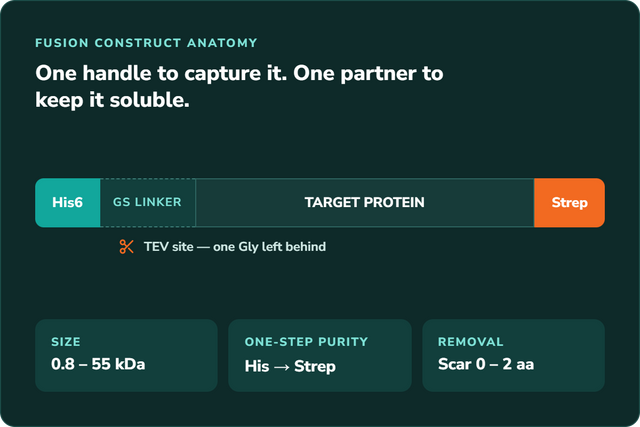 Protein Purification Tags: Which One Fits Your Model?A working comparison of protein purification tags — His, GST, MBP, Strep-tag II, FLAG, SUMO and the epitope tags —...
12 min read· Sep 2026
Protein Purification Tags: Which One Fits Your Model?A working comparison of protein purification tags — His, GST, MBP, Strep-tag II, FLAG, SUMO and the epitope tags —...
12 min read· Sep 2026
 PrimerSingle Cell RNA Sequencing Workflow: A Researcher's PrimerThe single cell RNA sequencing workflow explained stage by stage — the five principles it rests on, the seven bench...
14 min read· Aug 2026
PrimerSingle Cell RNA Sequencing Workflow: A Researcher's PrimerThe single cell RNA sequencing workflow explained stage by stage — the five principles it rests on, the seven bench...
14 min read· Aug 2026
 Application NoteHigh-Sensitivity ELISA Kit: When Sensitivity Changes the ResultA high-sensitivity ELISA kit pushes the lower limit of detection toward the sub-pg/mL range, turning a faint low-abundance signal into...
7 min read· Jul 2026
Application NoteHigh-Sensitivity ELISA Kit: When Sensitivity Changes the ResultA high-sensitivity ELISA kit pushes the lower limit of detection toward the sub-pg/mL range, turning a faint low-abundance signal into...
7 min read· Jul 2026
Recently viewed
Recently viewed products
Try Celltrypse Free – Request Your Sample Today
Experience the power of Celltrypse™, c-LEcta's innovative enzyme solution for gentle and efficient cell dissociation. Request your free sample and discover a superior alternative for your cell culture workflows.

Try Celltrypse Free – Request Your Sample Today
Experience the power of Celltrypse™, c-LEcta's innovative enzyme solution for gentle and efficient cell dissociation. Request your free sample and discover a superior alternative for your cell culture workflows.
