

BeaverBeads Magrose Heparin magnetic agarose beads as supplied. The dark brown colour of the suspension is characteristic of the heparin-derivatised agarose matrix.

BeaverBeads Magrose Heparin Affinity & Cation Exchange Magnetic Beads
Heparin-functionalised superparamagnetic agarose beads (30-150 um) carrying approximately 3 mg of heparin per mL of gel. Heparin acts both as a biological affinity ligand for antithrombin III, growth factors and nucleic acid-binding proteins, and as a cation exchange medium through its sulfate groups - two separation mechanisms in one bead.
Choose Size.
Overview
What is BeaverBeads Magrose Heparin Affinity & Cation Exchange Magnetic Beads?
Product Overview
BeaverBeads™ Magrose Heparin are superparamagnetic agarose microspheres carrying immobilised heparin. Heparin is unusual among purification ligands because it works two ways at once: it is a specific biological affinity ligand for growth factors, antithrombin III and a range of nucleic acid-binding proteins, and — because of its dense negatively charged sulfate groups — it is also a strong cation exchange medium for positively charged proteins at a given pH. One resin, two separation mechanisms.
The magnetic format removes the column. Crude protein samples do not need the repeated centrifugation and time-consuming filtration that column chromatography demands, there is no flow rate or column pressure to manage, and no chromatography instrument is required. The manufacturer reports that a skilled operator can extract high-purity protein in a very short time and run many samples in parallel.
Capacity and conditions
Ligand density is approximately 3 mg of heparin per mL of gel. Protein binding capacity is quoted as approximately 2 mg of antithrombin III per mL of beads — a reference figure, since real capacity depends on the target protein. Note that the product is a 10% (v/v) suspension, so 1 mL of what you pipette contains 100 µL of beads.
The manufacturer's starting conditions are a binding buffer of 50 mM Tris-HCl at pH 8.0 and an elution buffer of 50 mM Tris-HCl with 1–2 M NaCl at pH 8.0. Salt concentration and pH both change which proteins bind and how they release, so screen these for your target before scaling up.
Applications
Purification of antithrombin III and other coagulation factors, thrombin, growth factors, interferons, steroid receptors, lipoproteins, nucleic acid-binding proteins and restriction endonucleases. Also used as a general cation exchange capture step where a heparin-mimetic selectivity is wanted.
Handling and safety
Do not freeze, dry out or centrifuge the beads — all three cause aggregation that is hard to resuspend and damages the surface chemistry. Vortex or sonicate to an even suspension before every use. If the ethanol preservative interferes with your chemistry, wash the beads two or three times with purified water or buffer first. A magnetic separator is required. Keep beads and separators away from metal objects, electronic devices and implanted electronic devices such as cardiac pacemakers.
For Research Use Only. Not for use in diagnostic or therapeutic procedures. Specifications are those published by the manufacturer, BEAVER Biomedical Engineering Co., Ltd.
Details
Specifications
Applications
Applications & how to use
Protein Purification
Separating a target protein from a complex mixture while keeping it folded and active, using chromatography, spin columns, selective binding or buffer exchange. Recovery and retained activity matter more than purity alone, so an activity assay should accompany the gel at each step.
Protein Interaction
Detects and quantifies binding between a protein and a partner molecule, whether another protein, a nucleic acid, a lipid or a small molecule. Readouts range from gel shift and pull-down to fluorescence and label-free biophysics, and are used to confirm complex formation and measure affinity.
Evidence
Validation & QC
Validation data for this product isn’t published yet.
Need specific QC or validation results — titer, purity, endotoxin, or assay data — for your application? Our scientific team can share what is available for this product and lot on request.
Request validation dataManufacturing
How it's made & quality control
Supplier quality control
Magnetic and functionalized beads are QC-tested for size uniformity, binding capacity and lot-to-lot consistency for reproducible separation and purification.
Product sheets provide bead size, surface chemistry, binding capacity and recommended protocols.
Certificate of Analysis provided per lot with binding-capacity data.
Supplier-level quality statement. For lot-specific results, request the Certificate of Analysis for your batch.
Questions
Frequently asked questions
Is heparin an affinity ligand or an ion exchanger?
Both, which is the main reason to choose it. It binds antithrombin III, coagulation factors, growth factors, interferons and nucleic acid-binding proteins through genuine biological recognition. Separately, its sulfate groups carry a dense negative charge, so it also works as a strong cation exchanger for positively charged proteins. You can exploit either mechanism by choosing your buffer conditions.
What buffer should I start with?
Binding in 50 mM Tris-HCl, pH 8.0; elution in the same buffer with 1-2 M NaCl. Those are the manufacturer's reference conditions. Both salt and pH change what binds and what releases, so screen a small gradient before committing a large preparation.
How much protein will bind?
Approximately 2 mg of antithrombin III per mL of beads. That is a reference figure for one well-characterised target - your protein will differ. Remember the 10% (v/v) suspension: 1 mL of suspension contains 100 uL of beads.
Why magnetic instead of a heparin column?
No sample pretreatment. Column heparin chromatography needs repeated centrifugation and filtration to protect the bed; magnetic beads tolerate crude, particulate and viscous samples directly. You also avoid flow-rate control, back-pressure and the chromatography instrument itself, and you can run many conditions side by side.
Can I reuse the beads?
The manufacturer does not publish a regeneration protocol for the Heparin beads specifically. Standard practice is a high-salt strip followed by re-equilibration in binding buffer. Validate recovery of capacity before relying on reuse for quantitative work.
How should I store them?
2-30 C is tolerated; 2-8 C is recommended for long-term storage, with a 2-year shelf life. Never freeze, dry or centrifuge - each causes aggregation that is hard to reverse and damages the surface chemistry.
Answered by our team
Questions from researchers
No researcher questions have been answered for this product yet. Ask our technical team and we'll get back to you — approved answers are published here.
Ask our technical team
Reviewed by a scientist — typically answered within one business day.
Deals
Promotions
Codes apply at checkoutIn the literature
Research using this product
Every paper below mentions this product's catalogue number (or product name) in its full text — a text match, not a verified citation. Each entry shows what was measured, the sample type where the paper states it, and the sentence the catalogue number appears in, and a link to the figure showing that data — so you can confirm the use case before citing.
Auto-discovered from Europe PMC by manufacturer number / product name / keyword plus supplier. A match may reference a related product; confirm relevance before citing.
Customization
Customization & add-ons
BEAVER manufactures magnetic agarose beads at scale and supports OEM and ODM supply. Contact support@biohippo.com for scope and pricing.
- Bulk volumes: beyond the 4 x 250 mL catalogue pack, including litre-scale production.
- Related Magrose chemistries: DEAE (anion exchange), GSH (GST-tag), IDA-Nickel and IDA-Cobalt (His-tag), Strep-Tactin (Strep-tag II), Protein A / G / A-G, NHS, COOH, NH2 and OH.
- Custom ligand immobilisation: your ligand coupled to the Magrose matrix by the manufacturer.
- OEM / ODM supply: for kit and instrument manufacturers.
Explore
Collections featuring this product
This product is included in the curated collections below. Browse a collection to source everything for a workflow from a single cart.
From the blog
Related articles & guides
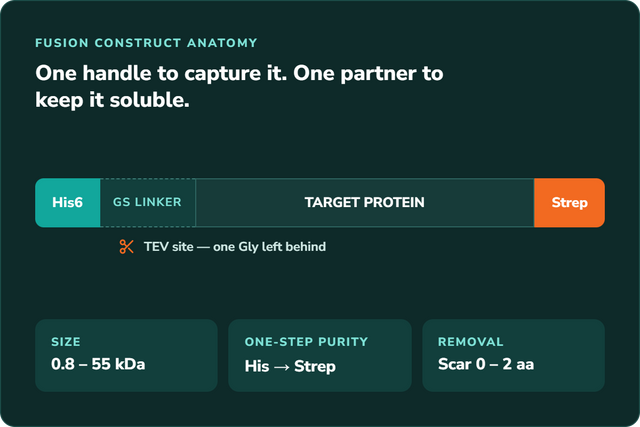 Protein Purification Tags: Which One Fits Your Model?A working comparison of protein purification tags — His, GST, MBP, Strep-tag II, FLAG, SUMO and the epitope tags —...
12 min read· Sep 2026
Protein Purification Tags: Which One Fits Your Model?A working comparison of protein purification tags — His, GST, MBP, Strep-tag II, FLAG, SUMO and the epitope tags —...
12 min read· Sep 2026
 PrimerSingle Cell RNA Sequencing Workflow: A Researcher's PrimerThe single cell RNA sequencing workflow explained stage by stage — the five principles it rests on, the seven bench...
14 min read· Aug 2026
PrimerSingle Cell RNA Sequencing Workflow: A Researcher's PrimerThe single cell RNA sequencing workflow explained stage by stage — the five principles it rests on, the seven bench...
14 min read· Aug 2026
 Streptavidin Magnetic Beads: How They Work, Protocol, and How to ChooseStreptavidin magnetic beads bind any biotinylated antibody, oligo, or protein — a universal capture handle for pull-down, IP, and nucleic-acid...
9 min read· Jul 2026
Streptavidin Magnetic Beads: How They Work, Protocol, and How to ChooseStreptavidin magnetic beads bind any biotinylated antibody, oligo, or protein — a universal capture handle for pull-down, IP, and nucleic-acid...
9 min read· Jul 2026
 Choosing Antibodies for Multiplex and Spatial Imaging PanelsHow to choose antibodies for multiplex immunofluorescence and spatial imaging panels: clone selection, fluorophore pairing, staining order, FFPE validation, cross-reactivity...
18 min read· Sep 2026
Choosing Antibodies for Multiplex and Spatial Imaging PanelsHow to choose antibodies for multiplex immunofluorescence and spatial imaging panels: clone selection, fluorophore pairing, staining order, FFPE validation, cross-reactivity...
18 min read· Sep 2026
Recently viewed
Recently viewed products
Try Celltrypse Free – Request Your Sample Today
Experience the power of Celltrypse™, c-LEcta's innovative enzyme solution for gentle and efficient cell dissociation. Request your free sample and discover a superior alternative for your cell culture workflows.

Try Celltrypse Free – Request Your Sample Today
Experience the power of Celltrypse™, c-LEcta's innovative enzyme solution for gentle and efficient cell dissociation. Request your free sample and discover a superior alternative for your cell culture workflows.
