

Phase-contrast micrograph of BeaverBeads Magrose NH2 magnetic agarose beads, showing the spherical morphology and the wide 30-150 um size distribution characteristic of the Magrose matrix. The dark inclusions are the Fe3O4 magnetic core material. Published by BEAVER Biomedical Engineering for Cat. 70203-5.

BeaverBeads Magrose NH2 Amino Magnetic Agarose Beads
Amino-functionalised superparamagnetic agarose beads (30-150 um) carrying approximately 50 umol of surface NH2 per mL of gel, with a saturation magnetisation of 41.09 emu/g. Used to immobilise carboxyl- or aldehyde-bearing ligands covalently, and as a starting surface for further chemical modification.
Choose Size.
Overview
What is BeaverBeads Magrose NH2 Amino Magnetic Agarose Beads?
Product Overview
BeaverBeads™ Magrose NH2 are superparamagnetic microspheres with an Fe3O4 core and an agarose shell carrying free primary amino groups on the surface. Amino beads are the complement to carboxyl beads: where COOH beads couple to amines on your ligand, NH2 beads couple to carboxyl groups, aldehydes or other amine-reactive chemistries on the ligand — useful when the ligand's own amines are in the binding site and must be left alone.
The agarose matrix is porous and hydrophilic, which gives more accessible surface per bead and markedly lower non-specific protein adsorption than a bare polymer surface. Magnetic response is fast enough that separation takes seconds on a standard separator.
Specification
Mean particle size 30–150 µm. Surface amino content approximately 50 µmol per mL of gel. Saturation magnetisation 41.09 emu/g. Supplied as a 20% (v/v) suspension. Shelf life 2 years at 2–8 °C.
Applications
Enrichment, separation and purification of biomolecules — proteins, peptides, oligonucleotides and drug molecules. Typical uses are building custom affinity supports by coupling a carboxyl-bearing ligand, glutaraldehyde-mediated immobilisation of proteins, immunoprecipitation with a covalently attached capture antibody, and as an intermediate surface for further chemical modification.
Choosing between Magrose surfaces
Within the BeaverBeads Magrose family: COOH (Cat. 70103) for coupling to ligand amines with EDC/NHS; NH2 (this product, Cat. 70203) for coupling to ligand carboxyls or through glutaraldehyde; NHS (Cat. 70702) already activated, for direct amine coupling with no activation step; OH (Cat. 70802) as an unfunctionalised starting surface. All share the same 30–150 µm magnetic agarose matrix.
Handling and safety
Do not freeze, dry out or centrifuge the beads — each causes irreversible aggregation and loss of surface activity. Vortex or sonicate briefly to an even suspension before every use. A magnetic separator is required. Keep beads and separators away from metal objects, electronic devices and implanted electronic devices such as cardiac pacemakers.
For Research Use Only. Not for use in diagnostic or therapeutic procedures. Specifications are those published by the manufacturer, BEAVER Biomedical Engineering Co., Ltd.
Details
Specifications
Applications
Applications & how to use
Immunoprecipitation (IP)
Enriches a target protein and its interacting partners from lysate using an antibody coupled to beads. Used for interaction studies and downstream WB or MS.
Protein Purification
Separating a target protein from a complex mixture while keeping it folded and active, using chromatography, spin columns, selective binding or buffer exchange. Recovery and retained activity matter more than purity alone, so an activity assay should accompany the gel at each step.
Bioconjugation
Covalent attachment of a biological ligand — antibody, protein, peptide or oligonucleotide — to a surface or another molecule. The chemistry chosen determines orientation and retained activity, so coupling through a residue distant from the binding site usually matters more than raw coupling efficiency.
Evidence
Validation & QC
Validation data for this product isn’t published yet.
Need specific QC or validation results — titer, purity, endotoxin, or assay data — for your application? Our scientific team can share what is available for this product and lot on request.
Request validation dataManufacturing
How it's made & quality control
Supplier quality control
Magnetic and functionalized beads are QC-tested for size uniformity, binding capacity and lot-to-lot consistency for reproducible separation and purification.
Product sheets provide bead size, surface chemistry, binding capacity and recommended protocols.
Certificate of Analysis provided per lot with binding-capacity data.
Supplier-level quality statement. For lot-specific results, request the Certificate of Analysis for your batch.
Questions
Frequently asked questions
When would I choose NH2 beads over COOH beads?
When the amines on your ligand are the part you need to keep free. COOH beads couple through your ligand's amines; if those sit in or near the binding site, coupling through them will cost you activity. NH2 beads let you couple through the ligand's carboxyl groups instead, or through an aldehyde using glutaraldehyde chemistry, leaving the amines alone.
What coupling chemistry should I use?
The two common routes are carbodiimide (EDC) coupling to a carboxyl on your ligand, and glutaraldehyde-mediated coupling. BEAVER does not prescribe one - the choice depends on your ligand. Screen on a small scale before committing material.
How much ligand can the surface hold?
Surface amino content is approximately 50 umol per mL of gel. How much of that converts into bound, active ligand depends entirely on the size and orientation of the ligand, so determine it empirically.
Why agarose rather than a polymer bead?
The agarose matrix is porous and hydrophilic. That gives more accessible surface per bead and much lower non-specific protein adsorption, which matters when you are pulling a low-abundance target out of a complex lysate. The trade-off is a larger, less monodisperse particle that settles faster.
How should I store them?
2-8 C, with a 2-year shelf life. Never freeze, dry or centrifuge - each causes aggregation that cannot be reversed and damages the surface chemistry.
Answered by our team
Questions from researchers
No researcher questions have been answered for this product yet. Ask our technical team and we'll get back to you — approved answers are published here.
Ask our technical team
Reviewed by a scientist — typically answered within one business day.
Deals
Promotions
Codes apply at checkoutIn the literature
Research using this product
Every paper below mentions this product's catalogue number (or product name) in its full text — a text match, not a verified citation. Each entry shows what was measured, the sample type where the paper states it, and the sentence the catalogue number appears in, and a link to the figure showing that data — so you can confirm the use case before citing.
Auto-discovered from Europe PMC by manufacturer number / product name / keyword plus supplier. A match may reference a related product; confirm relevance before citing.
Customization
Customization & add-ons
BEAVER manufactures magnetic agarose beads at scale and supports OEM and ODM supply. Contact support@biohippo.com for scope and pricing.
- Other Magrose surfaces: COOH (70103), NHS pre-activated (70702), OH (70802), and the affinity range - Protein A / G / A-G, GSH, IDA-Nickel, IDA-Cobalt, Strep-Tactin, Heparin, DEAE.
- Polymer NH2 beads: Mag NH2 at 2 um (70202) and 500 nm (70201) for automated and flow-based assays.
- Bulk volumes: beyond the 50 mL catalogue pack, at production scale.
- Custom ligand immobilisation: your ligand coupled to the Magrose matrix by the manufacturer.
Explore
Collections featuring this product
This product is included in the curated collections below. Browse a collection to source everything for a workflow from a single cart.
From the blog
Related articles & guides
 Streptavidin Magnetic Beads: How They Work, Protocol, and How to ChooseStreptavidin magnetic beads bind any biotinylated antibody, oligo, or protein — a universal capture handle for pull-down, IP, and nucleic-acid...
9 min read· Jul 2026
Streptavidin Magnetic Beads: How They Work, Protocol, and How to ChooseStreptavidin magnetic beads bind any biotinylated antibody, oligo, or protein — a universal capture handle for pull-down, IP, and nucleic-acid...
9 min read· Jul 2026
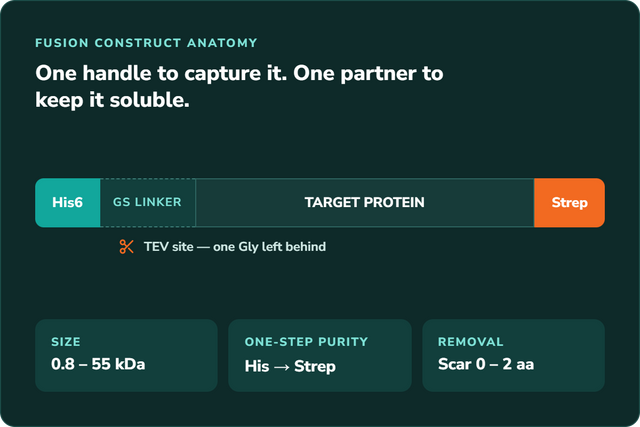 Protein Purification Tags: Which One Fits Your Model?A working comparison of protein purification tags — His, GST, MBP, Strep-tag II, FLAG, SUMO and the epitope tags —...
12 min read· Sep 2026
Protein Purification Tags: Which One Fits Your Model?A working comparison of protein purification tags — His, GST, MBP, Strep-tag II, FLAG, SUMO and the epitope tags —...
12 min read· Sep 2026
 PrimerSingle Cell RNA Sequencing Workflow: A Researcher's PrimerThe single cell RNA sequencing workflow explained stage by stage — the five principles it rests on, the seven bench...
14 min read· Aug 2026
PrimerSingle Cell RNA Sequencing Workflow: A Researcher's PrimerThe single cell RNA sequencing workflow explained stage by stage — the five principles it rests on, the seven bench...
14 min read· Aug 2026
 Choosing Antibodies for Multiplex and Spatial Imaging PanelsHow to choose antibodies for multiplex immunofluorescence and spatial imaging panels: clone selection, fluorophore pairing, staining order, FFPE validation, cross-reactivity...
18 min read· Sep 2026
Choosing Antibodies for Multiplex and Spatial Imaging PanelsHow to choose antibodies for multiplex immunofluorescence and spatial imaging panels: clone selection, fluorophore pairing, staining order, FFPE validation, cross-reactivity...
18 min read· Sep 2026
Recently viewed
Recently viewed products
Try Celltrypse Free – Request Your Sample Today
Experience the power of Celltrypse™, c-LEcta's innovative enzyme solution for gentle and efficient cell dissociation. Request your free sample and discover a superior alternative for your cell culture workflows.

Try Celltrypse Free – Request Your Sample Today
Experience the power of Celltrypse™, c-LEcta's innovative enzyme solution for gentle and efficient cell dissociation. Request your free sample and discover a superior alternative for your cell culture workflows.
