

BeaverBeads Protein A/G Antibody Purification Kit as supplied. The carton shown is labelled Cat. No. 20202-5.

BeaverBeads Protein A/G Antibody Purification Kit
A complete magnetic antibody purification kit built on 2 um NHS-activated beads covalently bound to recombinant Protein A/G, supplied at 30 mg/mL with binding, elution, neutralisation, washing, storage and regeneration buffers. Binds 1.8-2.0 mg of human IgG per mL of beads and delivers over 90% antibody purity in 30 minutes; the beads are reusable with a defined regeneration protocol.
Choose Size.
Overview
What is BeaverBeads Protein A/G Antibody Purification Kit?
Product Overview
The BeaverBeads™ Protein A/G Antibody Purification Kit purifies immunoglobulin in a single magnetic step. The beads are 2 µm superparamagnetic microspheres, NHS-activated and then covalently bound to recombinant Protein A/G, supplied at 30 mg/mL with a complete set of pre-formulated binding, elution, neutralisation, washing, storage and regeneration buffers.
Covalent attachment through NHS chemistry is what keeps ligand leaching low: the manufacturer states that residual Protein A in the purified antibody stays below the US FDA reference limit of 20 ppm. Antibody purity from a serum sample is reported at over 90% after one purification.
Speed and capacity
Human IgG binding capacity: 1.8–2.0 mg per mL of Protein A/G beads (the Protein A version, Cat. 20102, is quoted at 1.4–1.6 mg/mL). A skilled operator completes antibody adsorption in 15 minutes and the whole purification in 30 minutes.
Reusable, with a defined regeneration protocol
The kit includes a dedicated regeneration buffer. BEAVER recommends regenerating after five continuous uses: 5 mL of regeneration buffer per 1 mL of 10% (v/v) beads, mixed 10 minutes at room temperature, then two washes in binding/washing buffer and resuspension in storage buffer. The published durability data are 75% of original IgG binding capacity retained after 15 cycles, recovering to 90% after regeneration treatment, and no measurable loss of antibody binding after 8 weeks at 37 °C.
Two elution routes
Elution Buffer I at pH 4.5 is the gentler option and the manufacturer's default. Elution Buffer II at pH 2.0 is there for antibodies that bind too tightly to release at pH 4.5. Both are followed immediately by the neutralisation buffer. If elution is still incomplete, the manual suggests lowering the pH into the 1.9–2.5 range, raising ionic strength with 2–3 M MgCl2, or extending the elution time — while warning that antibodies aggregate readily at low pH, so neutralise promptly.
Sample types
Serum, blood plasma, ascites, cell lysate and tissue culture supernatant. The kit is also used for antibody immobilisation studies. A species and isotype affinity table in the manual lets you choose between the Protein A and Protein A/G versions for your antibody.
Handling and safety
A magnetic separator is required. Vibrate the beads thoroughly before use and keep them in storage solution so they never dry out. Do not freeze or centrifuge the beads — both cause irreversible aggregation. Keep beads and separators away from metal objects, electronic devices and implanted electronic devices such as cardiac pacemakers.
For Research Use Only. Not for use in diagnostic or therapeutic procedures. Specifications and protocol are those published by the manufacturer, BEAVER Biomedical Engineering Co., Ltd.
Details
Specifications
Applications
Applications & how to use
Protein Purification
Separating a target protein from a complex mixture while keeping it folded and active, using chromatography, spin columns, selective binding or buffer exchange. Recovery and retained activity matter more than purity alone, so an activity assay should accompany the gel at each step.
Immunoprecipitation (IP)
Enriches a target protein and its interacting partners from lysate using an antibody coupled to beads. Used for interaction studies and downstream WB or MS.
Evidence
Validation & QC
Validation data for this product isn’t published yet.
Need specific QC or validation results — titer, purity, endotoxin, or assay data — for your application? Our scientific team can share what is available for this product and lot on request.
Request validation dataManufacturing
How it's made & quality control
Supplier quality control
Magnetic and functionalized beads are QC-tested for size uniformity, binding capacity and lot-to-lot consistency for reproducible separation and purification.
Product sheets provide bead size, surface chemistry, binding capacity and recommended protocols.
Certificate of Analysis provided per lot with binding-capacity data.
Supplier-level quality statement. For lot-specific results, request the Certificate of Analysis for your batch.
Resources
Documents & downloads
Questions
Frequently asked questions
How is this different from the Protein A/G Immunoprecipitation Kit?
Different job, different bead loading. This kit purifies bulk antibody from serum or ascites: 30 mg/mL beads, 1.8-2.0 mg IgG capacity per mL, reusable, supplied with regeneration buffer. The IP kit (Cat. 22202) captures an antibody-antigen complex from lysate: 10 mg/mL beads, 0.5-0.6 mg/mL capacity, 25 uL per reaction, single-use. Buy this one to make antibody; buy the IP kit to pull down an antigen.
Protein A or Protein A/G?
Protein A/G binds a wider range of species and isotypes - notably rat IgG2a and IgG2b, mouse IgG1 and IgG2b, human IgG3, and bovine, goat, sheep and horse IgG, all of which Protein A binds weakly or not at all. Protein A (Cat. 20102) has slightly lower capacity at 1.4-1.6 mg/mL. Check the affinity table in the manual against your antibody's species and subtype.
How many times can I reuse the beads?
BEAVER recommends regenerating after every five continuous uses. Their published data show 75% of original capacity remaining after 15 cycles, recovering to 90% after a regeneration treatment. For quantitative work, verify recovery on your own antibody rather than relying on the figure.
Why are there two elution buffers?
Buffer I at pH 4.5 is the default and the gentler of the two. Buffer II at pH 2.0 exists for antibodies that will not release at pH 4.5. Use the mildest condition that works, and add the neutralisation buffer immediately - antibodies aggregate readily at low pH.
My antibody still will not elute. What else can I try?
Drop the elution pH into the 1.9-2.5 range, raise ionic strength with 2-3 M MgCl2, or extend the elution time. All three trade recovery against the risk of aggregation and activity loss, so neutralise fast and check the eluate.
Will Protein A leach into my purified antibody?
Some ligand leaching is unavoidable with any Protein A resin. BEAVER couples the ligand covalently through NHS chemistry and states that residual Protein A stays below the US FDA reference limit of 20 ppm. If your application is sensitive to it, assay the eluate.
Do I need a magnetic separator?
Yes, and it is not included. Cat. 60201 fits 1.5 mL, 2 mL and 15 mL tubes; Cat. 60203 fits 50 mL tubes.
Answered by our team
Questions from researchers
No researcher questions have been answered for this product yet. Ask our technical team and we'll get back to you — approved answers are published here.
Ask our technical team
Reviewed by a scientist — typically answered within one business day.
Deals
Promotions
Codes apply at checkoutIn the literature
Research using this product
Every paper below mentions this product's catalogue number (or product name) in its full text — a text match, not a verified citation. Each entry shows what was measured, the sample type where the paper states it, and the sentence the catalogue number appears in, and a link to the figure showing that data — so you can confirm the use case before citing.
Auto-discovered from Europe PMC by manufacturer number / product name / keyword plus supplier. A match may reference a related product; confirm relevance before citing.
Customization
Customization & sourcing
Related BEAVER products available through BioHippo. Contact support@biohippo.com for scope and pricing.
- Protein A only kit: Cat. 20102-1 / -5 / -25, same format, 1.4-1.6 mg/mL human IgG capacity.
- Immunoprecipitation kits: Protein A/G (Cat. 22202) and Protein A (Cat. 22203).
- Agarose-matrix alternatives: Magrose Protein A (Cat. 70804) and Magrose Protein G (Cat. 70805), 30-150 um.
- Magnetic separator stands: Cat. 60201 (1.5 / 2 / 15 mL), 60203 (50 mL), 60302 and 60303 (96-well plates).
- OEM / ODM supply: bulk beads and custom kit configurations.
Explore
Collections featuring this product
This product is included in the curated collections below. Browse a collection to source everything for a workflow from a single cart.
From the blog
Related articles & guides
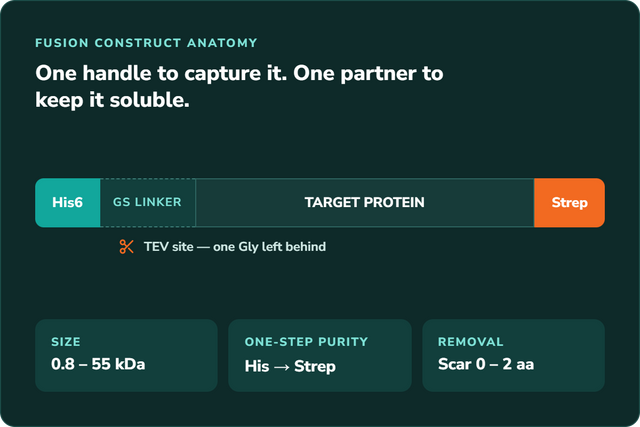 Protein Purification Tags: Which One Fits Your Model?A working comparison of protein purification tags — His, GST, MBP, Strep-tag II, FLAG, SUMO and the epitope tags —...
12 min read· Sep 2026
Protein Purification Tags: Which One Fits Your Model?A working comparison of protein purification tags — His, GST, MBP, Strep-tag II, FLAG, SUMO and the epitope tags —...
12 min read· Sep 2026
 Streptavidin Magnetic Beads: How They Work, Protocol, and How to ChooseStreptavidin magnetic beads bind any biotinylated antibody, oligo, or protein — a universal capture handle for pull-down, IP, and nucleic-acid...
9 min read· Jul 2026
Streptavidin Magnetic Beads: How They Work, Protocol, and How to ChooseStreptavidin magnetic beads bind any biotinylated antibody, oligo, or protein — a universal capture handle for pull-down, IP, and nucleic-acid...
9 min read· Jul 2026
 Choosing Antibodies for Multiplex and Spatial Imaging PanelsHow to choose antibodies for multiplex immunofluorescence and spatial imaging panels: clone selection, fluorophore pairing, staining order, FFPE validation, cross-reactivity...
18 min read· Sep 2026
Choosing Antibodies for Multiplex and Spatial Imaging PanelsHow to choose antibodies for multiplex immunofluorescence and spatial imaging panels: clone selection, fluorophore pairing, staining order, FFPE validation, cross-reactivity...
18 min read· Sep 2026
 Research guideWeak or Inconsistent iPSC Culture Results? Start HereA four-step diagnostic guide to iPSC culture troubleshooting: run the 30-minute triage, classify which of four failure patterns you are...
12 min read· Aug 2026
Research guideWeak or Inconsistent iPSC Culture Results? Start HereA four-step diagnostic guide to iPSC culture troubleshooting: run the 30-minute triage, classify which of four failure patterns you are...
12 min read· Aug 2026
Recently viewed
Recently viewed products
Try Celltrypse Free – Request Your Sample Today
Experience the power of Celltrypse™, c-LEcta's innovative enzyme solution for gentle and efficient cell dissociation. Request your free sample and discover a superior alternative for your cell culture workflows.

Try Celltrypse Free – Request Your Sample Today
Experience the power of Celltrypse™, c-LEcta's innovative enzyme solution for gentle and efficient cell dissociation. Request your free sample and discover a superior alternative for your cell culture workflows.
